Blog's Translator

sabato 4 febbraio 2012

Semel In Anno Licet Insanire

A mask from the Carnival of Venice, this year on
February 4th-21st, 2012.
Visit the official website!


When I grew up we still studied Latin in compulsory school in Italy, it was about 1979 when this important subject was abolished. "Semel in Anno Licet Insanire" is the Latin expression that I remember with most joy from middle school and it means "Once every year it is acceptable to be crazy", referring to the Carnival rite of liberation and giving out the authorization not to respect conventional religious and social rules within its celebrations' time frame.

A curiosity about Italian Carnivals comes from the end of the Renaissance times and exactly from 1575, the date of the 11th Jubilee of the history of the Catholic Church and Holy Year announced by Pope Gregory XIII in the name of prayer, preaching, repentance and charity.  It was the last Jubilee of the 1500s and the first one after the Council of Trento (1563).

Indeed Pope Gregory XIII for the Jubilee of 1575 among other important dispositions abolished the expenses for the Carnival masks (and any other amusements) and donated the money they saved to the hospital for pilgrims of Filippo Neri in Rome.

The Jubilee of 1575 was very important for the history of the Catholic Church, a starting point of renewal and rebirth from the Jubilee crisis in the Middle Ages. About 400,000 pilgrims visited Rome that year, whereas the city of Rome itself enumerated 80,000 inhabitants only. Confraternities were the Jubilee novelty and among other services, they organized pilgrims' processions, to one of which Pope Gregory XIII took part naked feet like any other pilgrim and mixed in the crowd.

Original bronze medal of the Jubilee
of 1575 found in the fields in the
area of Deruta, Italy
(Front, writing "Salvator Mundi").
Private property 
The Jubilee of 1575 was very well organized and pilgrims were given or could buy for the first time commemorative medals that came in different shapes and patterns. The tradition of Jubilee medals actually started with Pope Gregory XIII in this Holy Year. We are showing here the medal that a pilgrim probably lost in the fields in the area of Deruta, we assume on his/her way back from Rome.

The rear of the pilgrim's medal of the
Jubilee of 1575, dimensions 1"x3/4"
The medal front represents Jesus profile with the words "SALVATOR MVNDI" (tr. savior of the world) while the medal rear carries the following writing all around the border: "IVSTI ENTRABVNT PER EAM AM IVBILEI" (tr. The righteous will go through this door on the Jubilee), within the holy door itself the date of the Jubilee, MDLXXV, 1575 and Rome underneath the holy door.

Thinking of doors, "Chiusa una Porta, si apre un Portone" is a popular expression in Italy translating "when a door closes, a gate opens", therefore you never miss your opportunities of rebirth. Sometimes life may unexpectedly open up a holy door to you!


-----------------------------------------

- Original Posts by Roberta Niccacci -

FRIENDS OF CAMA 
Join the Facebook Page to Receive Blog Updates 

NEW!

Now on Twitter

martedì 17 gennaio 2012

From a homeless workshop in Deruta, Italy to the homeless in the United States


This pattern is called "Ricco
Deruta", the portrait of
the town. 


Last year Cama donated forty beautiful ceramic coffee cups and saucers for the fundraiser of October 22nd, 2011 called "Hats and tea fashion show and silent auction". The event was a success attracting 300 supporters. Attendees were thrilled and the bidding on the cups was fierce! 

The Church of Mary Magdalene and Mary's Place organized the event which is going to support the homeless women and children of Seattle. 

The event took place in Mercer Island , Washington but the cups and saucers were originally sent out to California, where the beautiful 
and original story of the Friends of Cama started back in 2010.

This is the cup and saucer
from the movie "Mrs.Doubtfire"
by Cama. 
                               
In May 2010 a group of fans of Cama gathered together to support Cama for love and out of their heart and passion for the art of Cama. These customers and fans first thought of starting asking for donations to send to Cama. We agreed to do this but after a little we thought this was too much. The second idea was organizing fundraisers for Cama called  "Coffee for Cama" to raise money. 
                                      
In the meantime we sent out coffee cups and saucers, dessert plates and mugs for the event in the United States. 

A historical pattern from Deruta
"Raffaellesco"
Indeed back in Italy we were feeling that none of the ideas to support Cama  would have brought Cama back to life, because soon after the workshop and the painters were no longer available to make new orders. The workshop officially closed in June 2011 but the production had stopped earlier.

More ideas came up and at the end the project became "Coffee with Cama" and we tried to organize a fundraiser for a hospital for children in California but because of my lack of experience, the difficulty with laws and other matters, we were giving up. It was not the right moment for the fundraiser.

The group of friends in California was called "Friends of Cama". 

The cup and saucer seen on the
cover of the book
"Passion for Coffee" by Starbucks,
first edition. 
In the beginning of 2011 we were feeling hopeless and my friend Mary in California was ready to send the ceramics back when I met Lisa from the Church of Mary Magdalene in Seattle, Washington. When I heard the word "homeless" I did not hesitate a moment to send the ceramics to their Church and to the homeless in Seattle.

We look forward to the success of Cama
in resuming their work.
(Photo credit: Angela Tunner) 
"Home" was the word in common with Cama!
This is how the story of the Friends of Cama has come along.

The dessert plates and the mugs are now ready for the next appointment with the Church of Mary Magdalene and Mary's Place in Seattle, Washington mid-May 2012! We will keep you posted and send you a "save the date" note for the next and final fundraiser with the Cama Deruta ceramics. 

The latest updating is that in this moment Cama is still without a home while I have opened a page to honor the Friends of Cama on facebook following the happy ending story of Cama. We look  forward to the happy ending hopefully within this year!  

It would be wonderful to celebrate this upcoming event in May with good news from Italy. In the meantime at Cama we have been happy to help our American friends in Seattle. 


Cama Deruta on facebook: www.facebook.com/friendsofcama
Church of Mary Magdalene:   https://www.facebook.com/churchofmarymagdalene 
Mary's Place: https://www.facebook.com/marysplacedaycenter   I love your logo! 
Lisa Connolley's Blog: www.gowithmarys.blogspot.com   (on the 15th of August 2011 Lisa bacame my god-daughter). 


-----------------------------------------

- Original Posts by Roberta Niccacci -

FRIENDS OF CAMA 
Join the Facebook Page to Receive Blog Updates 

NEW!

Now on Twitter

mercoledì 11 gennaio 2012

The Niccacci families in Deruta and the Franciscan friars

The famous friars that you could find in Assisi were
made by Fratelli Niccacci.
The workshop closed about 2009/ 2010.
(Photo credit: Fratelli Niccacci)


The Niccacci families are probably from Tuscany but have been established in Deruta for many generations. The Niccacci families are all related, a total of five main groups of families in the same town. By being in Deruta, members of the Niccacci families were involved or are still involved in ceramics.

Mr.Aldo Niccacci of the "Fratelli Niccacci" closed his business around 2009/2010 after his retirement. He used to produce the famous ceramic Franciscan friars for Assisi and also the "Della Robbia style" reproductions on white clay. The workshop was located on the edge of town, beyond all the touristy shops and exactly in the "Barche" neighborhood. The "Fratelli Niccacci" have served Assisi for decades and it is still possible to find some of his friars in the touristy shops in Assisi. His friars were fun!


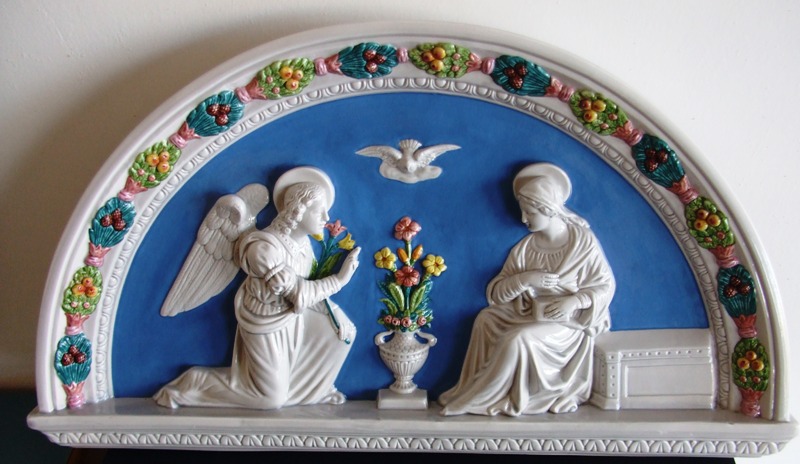
The reproduction of the Annunciation of the Hospital of the Innocents
in Florence was made by Fratelli Niccacci. (the photo is mine, 
a replacement service I did
for the St. Bede Parish in Pittsburgh PA)


On the contrary the "Della Robbia style" ceramics plaques of "Fratelli Niccacci" were interpretations of the original plaques made in Montelupo Fiorentino, Italy located in Tuscany ( also known as the furnace of Florence) and originally on red clay. Most American customers preferred the plaques on white clay, which are smoother, with fewer flaws, and more precise, these ones in particular.
The "Fratelli Niccacci" still has pieces in stock and I had the opportunity to visit Aldo Niccacci last year to serve a Church in Pittsburgh, PA for the replacement of a broken piece. I was lucky to find the last piece available and the exact one the customers were looking for:  the perfect match and a beautiful experience of service!

Curiosity: the signature on the pieces was "Maioliche F.lli Niccacci Deruta", followed by the article number.  "F.lli" is short for "Fratelli" the same as "Bros" for "Brothers".


Additionally in Deruta, the activity of the Niccacci families is very well represented by Francesca Niccacci,  who specializes in the field of Renaissance reproductions of ceramic portraits and historic scenes. She is a pupil of Maestro Romano Ranieri and she has been carrying on the tradition of portrait plates for many years. She also makes large urns and home accessories.

A classical ceremony plate of the Renaissance times in
Deruta. Tr. Art and Love, original writing in Latin according
to the 16th-century tradition (photo credit: Francesca Niccacci). 
Francesca Niccacci opened her own workshop many years ago when she was single, later on, helped by her husband, and recently moved to the area where her family is originally from, the famous "Molinella" neighborhood in Deruta, located in the Northern part of the town towards Florence. Francesca is closely related to Padre Rufino Niccacci, the famous Franciscan friar who saved the Jews in Assisi during the Second World War.

To see the work of Francesca Niccacci visit: www.vecchiaderuta.it. Francesca Niccacci is mentioned in the art literature in the United States as one of the few women in Deruta to start up her own business.

Another group of the family is represented in ceramics by Maria Assunta Niccacci and her father Domenico. They have a workshop where they produce white slip clay pieces that they export and sell nationally. Last, not least Renato and Elena Niccacci, my parents, owners of Cama Deruta, by whom this blog is inspired and who are carrying the longest tradition in ceramics and the most wonderful audience.

Antico Deruta pattern by Cama created by Elena Niccacci
We encourage buying directly from the workshops in Italy, this will help the artists save their art. If the workshops are closed and/or you are looking for specific pieces, please feel free to contact us at: friendsofcama@gmail.com. With our "ceramics hunting service" we will be happy to help you finalize your research. Thank you in advance for your patronage.


----------------------------------------


Original Posts by Roberta Niccacci -

FRIENDS OF CAMA 
Join the Facebook Page to Receive Blog Updates 


NEW!

Now on Twitter

lunedì 2 gennaio 2012

As perfect as decals

A mosaic planter seen in the front garden of a home
in Deruta, Italy. 


"Your products were beautiful and so perfect that they did not look to be handpainted" wrote Mr. Robert P. from Middletown, MD about Cama Deruta handpainted pieces. Nowadays the fact of ceramics being as perfect as transferwares seems to be quite a compliment.

Perfection in Deruta handpainted ceramics is part of the recent history of the past twenty/thirty years, when Deruta ceramics were in the best retail stores in the United States at expensive prices and in large quantities.

I remember when I was at Biordi's in San Francisco as a resident expert in the early 1990s and more recently in 2006, a customer from New York sent back a beautiful Ricco Deruta rectangular tray because of a tiny little hole on the surface of the glazing. We sent another one back as a replacement without any comments. In Italian there is a saying "Customers are always right" ("Il cliente ha sempre ragione").

When you reach such a perfection as part of the demand of the market, you crash defective pieces into mosaics or you sell these pieces at lower prices to friends or to returning customers at the workshop, making sure that the irregular pieces will not be subject to requests of exchange. In retail stores in the United States you may find sometimes corners of ceramic pieces with the "as is" sign.

I remember a customer visiting Cama and looking for pieces to be adopted, horphans. How sweet of her! The customer looked at the irregular pieces with lots of love and interest. Indeed in defective pieces there is the same amount of work, of love and of passion and some sort of uniqueness. Most of the time there is even more work, because the piece goes through at least one touch up and refiring. Additionally when refiring oval platters, wall plates or cake plates for instance the chance of losing the pieces is very high. The pieces are likely to crack or split in half.

The striving for perfection made us into such perfectionists at Cama Deruta that sometimes it was difficult even for us to spot the defects. To the United States we sent out only flawless pieces and in flawless cardboards. A lot of work and great satisfaction.

In the world of high-end quality porcelains (ceramics made of kaolin such as by Richard Ginori in Italy or the more famous German porcelains) the rule is that irregular pieces will not enter the market and will be destroyed without any attempt to recover them, which makes the cost of porcelains raise considerably.

Hopefully resuming work soon, I miss the work of Cama, it has such a distinctive personality, I would recognize it everywhere, I love it so much!


-----------------------------------------

- Original Posts by Roberta Niccacci -

FRIENDS OF CAMA 
Join the Facebook Page to Receive Blog Updates 

NEW!

Now on Twitter

mercoledì 7 dicembre 2011

Deruta decals


In Deruta the recent fight against "fakes" of Deruta handmade ceramics has caused enormous troubles in the town of Deruta and within its community. The town Hall and the Consortium of Ceramicists called "Deruta 1282" were convinced that the problem of the market of handmade ceramics being stuck was due to counterfeits=Deruta patterns reproduced by the use of decals, plastic printed films over the glazing, considered as fakes. A variation of the low quality products painted in China and in Romania. Therefore in 2008 they started a campaign against counterfeits. Before going to China or to Romania, they started by attacking local producers: a couple of decal ceramics factories are located in the city of Deruta and another one was located in the neighborhood of Assisi.

The presentation photo of decal Deruta
dinnerware sets in the "Sur la Table"
online store, called Deruta-style.

Photo credit: Sur La Table
One of the companies in Deruta that produces decal tableware is the official supplier of the U.S. company "Sur la Table", chain stores first established in Seattle, Pike Place Market in 1972. Sur la Table on their online store advertise their decal product from Deruta as "Deruta-style collection". Worth of notice is that small parts of the products are handpainted, such as the rims on the plates or the top of the salt and pepper shakers. 

These decal ceramics can be designated as "decorated by hand", where the word "decorated" as a literal translation of "decorato"  means that a person lays down a piece of printed film on the surface of the plate with the use of their hands. The verb "decorare" in Italian also means "painting by hand"; "decoratrice" (for a woman) "decoratore" (for a man) is the name for the ceramics artists on their official paperworks. 

Decal has been in use in Deruta for many years, companies such as "Ars Artigiana" have experimented this technique several years ago as well as "Santucci ceramics" which supplied the Perugina chocolate company with ceramics items to go with their candy products. 

Probably the point was that it is not legitimate to reproduce traditional handpainted patterns by the use of decals and by using the name of the town of Deruta. The question is: how can you fulfill the demand of chain stores and their customers who wish to have the flavor of handpainted traditional ceramics on their table at a reasonable price?


-----------------------------------------

- Original Posts by Roberta Niccacci -

FRIENDS OF CAMA 
Join the Facebook Page to Receive Blog Updates 

NEW!

Now on Twitter

sabato 3 dicembre 2011

Majolica of Orvieto, Italy

The Saint Catherine of Alexandria ceramics plaque
in the Church of Saint Francis in Deruta.
See detail of the pitcher, lower left, in the archaic style
(Deruta, 1919).


We continue our virtual visits to the ceramics towns in Italy by following the map of the AICC (Official Association of the Ceramics Towns in Italy). AICC confirms that the ceramics towns in our region, Umbria, are as follows: Deruta, Gualdo Tadino, Gubbio and Orvieto.

Although Gubbio and Gualdo Tadino carry on the tradition of luster ceramics, which was also traditional in the Renaissance in Deruta, Orvieto is currently the town that has the most history in common with Deruta in terms of popular patterns. 


The Orvieto green rooster pattern,
 inspired by the city of
Orvieto and produced in Deruta
(Pitcher by Cama).  
Indeed Deruta carries a pattern with the name of this beautiful town, the Orvieto green rooster, which is a best seller in American stores during Christmas time. 

Christmas berries: colors in common with
the classical Orvieto Green Rooster pattern
from Deruta, Italy 
The Orvieto green rooster pattern is the most Medieval looking of all the patterns that you may find in the palette of Deruta classical patterns. The rooster is a cheerful addition of the painters of Deruta in the early 1900s. 

Classical shape and pattern from Orvieto, Italy
- Alexandre Imbert collection -
There are some original ceramics workshops in Orvieto, not as many as in Deruta and many shops where they sell ceramics from Orvieto, Deruta and Montelupo Fiorentino. If you are looking for authentic traditional pieces, one of the local studios in Orvieto is the "Laboratorio Ceramica L'Arpia" on Corso Cavour 186, operated by a single artist who makes interesting accessories for the home and reproductions from original Orvieto products. It gives you the actual feeling of the traditional Orvieto style of the archaic period. That is what we think of when we think of Orvieto classical ceramics. 

Regarding Orvieto traditional patterns, with leaves and portraits, local ceramics artists in Orvieto are proud of the fact that they do not use the tracing paper like we do in Deruta. 

The tracing paper was the invention of Renaissance artists to reproduce their frescoes on the walls of Churches and homes based on the original work on paper. Close-ups from the Sistine Chapel in the occasion of the last restoration show nail dots on the outlining. The tracing paper is necessary in case of intricate works and when the goal is to obtain the best consistency to the original work. The tracing paper is not an easy tool to use, it is usually the best artist who does the outlining on the charcoal dots with very fine brushes. It is important not to confuse the tracing paper with the stencil. 

The bottom part of the ceramics plaque of Saint Catherine of Alexandria
with the writing in Latin:
"PICTORES  DIRUTAE  A.D. MCMXIX" (the painters of Deruta, 1919 AD).  


When the tradition of ceramics started in Deruta in the late 1200s, pieces were very similar to the ceramics of Orvieto, with few colors namely two base colors:  green (originating from copper), brown (originating from manganese) and their shades. 

Most of the pieces in Deruta were glazed and painted on the upper part only and this technique was called "A Risparmio" (economical), because this allowed the artists to save money on the glazes, colors and on the painting time. 

The artist of the reproductions of similar archaic pieces of Deruta is Carla Cornia, who in 1979 moved from Northern Italy to Deruta because of her passion for the art of ceramics. She owns a studio downtown Deruta. 

Reproduction of an archaic Deruta piece by Carla Cornia"aeconomical style" 
In this piece just a little saving...

-----------------------------------------

- Original Posts by Roberta Niccacci -

FRIENDS OF CAMA 
Join the Facebook Page to Receive Blog Updates 

NEW!

Now on Twitter


venerdì 2 dicembre 2011

Porcelains of Naples, Italy

Ceramics towns in Italy according to the accredited Italian
"Ceramics Towns Association" (AICC).
Six ceramics towns in the region of Campania, 36
ceramics towns in total all over Italy.

Idea for a long weekend in Italy from Dec.8th (public holiday) to Dec.11th:
paying a visit to Naples and the Amalfi Coast. How romantic! 

Ceramics is the general name for several products, from majolica to porcelains,  from water closets to floor tiles and raw bisqueware. The specific name of  each ceramics depends on the clay, the process and the finishing of the products, varying if it is art ceramics or industrial ceramics.  

The town of Naples is also listed, being the city famous for its ceramics nativity scenes and for its porcelains traditions. 

The ceramics nativity scenes are displayed every year in Naples in the neighborhood of  San Lorenzo the second week of December, starting on December 8th (Feast of the "Immacolata"), on San Gregorio Armeno Street and new figurines are added every Christmas, some of which are really trendy, about the latest news,  portraying politicians, v.i.p.s, famous showgirls, singers and top models. Many of these figurines are
humorous.


On the right Mr. Mario Monti,  the new Italian Prime Minister and in the
back Mr. Silvio Berusconi with the sign "resigning immediately"
(Nativity figurines from Naples, Italy, 2011)
Homage to Mr.Steve Jobs
(Nativity figurine from Naples, Italy, 2011)


Madame Carla Bruni and Mr. Nicolas Sarkozy
with Giulia
(Nativity figurines from Naples, Italy, 2011)
                                   
The tradition of ceramics nativity scenes goes back in Naples to the 1700s, the same century when King Carlo di Borbone and his wife Maria Amalia di Sassonia established the first porcelain factory in the neighborhood of Capodimonte in Naples and named it: "Real Fabbrica di Capodimonte" (Royal Factory of Capodimonte) inside the famous Capodimonte Royal Palace, nowadays ceramics museum and picture museum with private ceramics collections that go back to the late 1400s and to the Italian Renaissance.  

So many ceramics towns in Italy! 

In Campania, the region of Naples you may visit Vietri sul Mare for majolicas (indeed the city was founded by the Etruscans), then Ariano Irpino for ceramics nativity scenes, Cerreto Sannita and San Lorenzello for their majolicas tradition going back to the 1600s, Cava dei Tirreni for their ceramics industrial tiles. Vietri sul Mare is the only ceramics town that I visited personally, I do not have any experience about the other cities. 

The Amalfi Coast, Unesco World Heritage Site
for its landscape
On the Amalfi Coast the most visited town is Ravello, where it is possible to purchase colorful geometric Deruta ceramics upon selection of local retail stores. Ravello is not listed by the AICC among the ceramics towns of Italy, because their ceramics are imported from other cities in Italy, such as Deruta which is their best seller. 

giovedì 1 dicembre 2011

Majolica of Siena, Italy


Tourist shops in Italy request the name of their city as
a signature.  Otherwise they do not buy from your workshop.


 Siena is a wonderful example of Italian Art. The Cathedral of Siena is a beautiful art container starting from its famous black and white marble floor to the "Piccolomini Library". The Cathedral marble floor has inspired the "Siena" pattern with the sitting deer. 

Example of original Siena artwork on wood
(by  Ambrogio Lorenzetti,  1290-1348)
called "Trittico di Badia a Rofeno" and recently restored. 


Siena is also among the tourist cities in Italy where you can find Deruta ceramics signed "Siena, Italy". In fact the Siena pattern articles in particular come from Deruta, at least most of the production until the 1990s, because in the meantime a few artisans in Siena have opened their own ceramics shops. They specialize in the Siena contrades in particular and they might produce some of the Siena pattern, known there as "Black and white" pattern. The rest of the ceramics in their shops comes from Deruta and from Montelupo Fiorentino, the historical ceramics town of Florence. Montelupo Fiorentino has its own specific style and flavor. Very different from Deruta.

Indeed Siena does not have a ceramics tradition, historically they are famous for their wonderful paintings on wood with gold leaf backgrounds dating back to the Middle Ages. I also remember that there were workshops  in Siena selling reproductions of their art on wood.

Quality ceramics are like a signature. You may recognize them
from the shapes and the style of the patterns. 
A few days ago an American lady, possibly a reader of this blog, wrote to me about a piece that she purchased in Siena in 1993 on her honeymoon. She was asking information about who made her lovers'
cup. She wrote that she loved it! This was so easy for me to answer, because this cup, that a couple could drink from at the same time, was made at my family's workshop, Cama!
The two spouts are handmade straws. The couple can drink
from the cup at the same time. My aunt Antonia was
specialized in attaching handles, spouts and finishing.
She is now retired. On this piece she did the spouts and the
sponging. 

This lovers' cup was handthrown on the wheel by my uncle Luigi in two separate pieces: the cup itself and the stand.

The process of handthrowing is very long. The piece has to dry and afterwards it is trimmed with a special tool, when it is hard enough it can be sponged. The spouts are attached after the trimming. Each piece is tested before the first firing to check if the straws are working. The painting comes as a second step.

This is why it is possible to separate the two steps of the production.

The reason why new ceramicists open their own workshop in tourist cities in Italy is because in the 1990s in Deruta several artisans started a production of raw buisqueware that they distributed outside of Deruta.
This action has contributed to the decline of the tradition of Deruta, in terms of specific denotation of the place of origin. In some ways an example of globalisation.

Why shapes are important? Because for instance Deruta is famous for its round shapes handthrown on the wheel. Shapes from Deruta were originally different from the shapes of Nove, Montelupo Fiorentino, Castelli, Vietri, Santo Stefano di Camastra, some of the ceramics towns in Italy. The clay itself was different.

Likewise I would like to point out that the Amalfi Coast does not have a ceramics tradition in terms of "majolica" in the style of Deruta, the ceramics you find in Ravello are from Deruta, unless they come from Vietri (Salerno Province), whose style is completely different. This is why Ravello is not listed among the ceramics towns in Italy.


giovedì 27 ottobre 2011

Catherine de' Medici at the court of France

Catherine de' Medici  1519-1589
A Barbie doll with the reproduction of the
original wedding dress of Catherine de' Medici,
created by the artisans of the city of Florence in 2008. 

Piegaro, Italy is a small town in the northwest of Umbria, historically considered as a borderland between Umbria and Tuscany. At one time Piegaro was called "The Little Paris".  Piegaro has a lot in common with Tuscany, you might even hear people speak with a Florentine accent here.

Thinking of the important tradition that Tuscany has in its relationship with France, I may guess why something French might be considered as classy, sophisticated, and elegant and echoing here in Piegaro.

As a consequence, there must be historical reasons for this French influence and the first princely person we think of is the Florentine Catherine de' Medici, Queen of France.

Catherine belongs to the famous Medici family from Florence. In 1533 she got married to the king of France Henry II and she became Queen of France in 1547 at the age of 28.  Catherine and Henry had ten children, among which several monarchs.


The classical scalloped dinner
plate in the Ricco Deruta
pattern (By Cama). 
During her reign at the court of France, Catherine de' Medici brought fresh air and innovations directly from Italy. She brought chefs from Florence and revived the French cuisine, she introduced the fork, that the French did not use and at her dinner tables she only used scalloped shaped plates  (that are still best sellers in Deruta versus the smooth rim plates).

A book about the art of  needlework
to learn the Renaissance original
style of Catherine de' Medici. 
Catherine was also a great "cultrice d'ago" (tr. expert in needlework) and she created her own pattern, nowadays known as "Punto Madama Caterina" (tr. Madame Catherine's needlework) that became very popular among the ladies of the court of France.

Catherine de' Medici was a grand patron of the arts in France according to her family tradition back in Italy and there is a long list of countless art activities that she accomplished at the French court, which made her unforgettable.

A close-up of the Barbie doll.
The artisans first reproduced the original dress
full size and made the miniature afterward. 


In Deruta many years ago there was a famous needlework laboratory owned by the Corcioni sisters.

Among their artwork, they listed the "Punto Madama Caterina" or "Punto Caterina de' Medici" which has been brought back to life in the past decade by the Cultural Association "Ars Umbra", located in Deruta, President Anna Lisa Piccioni.

Follow this link to admire a modern celebration of the Renaissance tradition of needlework in Umbria.
Follow this link to read about the latest exhibition about Caterina de' Medici in Florence, Palazzo Strozzi, 2009.


-----------------------------------------

- Original Posts by Roberta Niccacci -

FRIENDS OF CAMA 
Join the Facebook Page to Receive Blog Updates 

NEW!

Now on Twitter

lunedì 17 ottobre 2011

Apple's apple and the Renaissance tradition of the "Impressum"

The successful Apple's brand logo
has classical origins. 


"Impressum" is a Latin word that in English translates "symbol" or "image" but it is more than this. It was a Renaissance tradition that nobles selected a maxim that was meaningful of their princely personality - usually a riddle or a play-on-word and a scene and/or a symbol. This creation was called "Impressum". The Impressum is very similar to a coat of arms/emblem, also known as a "device". 


Beyond Apple's success, an apple with a bite (a play on word with "byte") as a brand logo, there is an intimate relationship with the classical cultural codes coming from Greek and Latin traditions and in use in the Renaissance period. Apple's apple in particular is a synthesis of an original 16th century "Impressum".  Indeed Apple's logo is considered as the most meaningful example of how classical arts and traditions still influence the modern world of marketing and advertising. An interesting book about this subject is "L'originale assente" (tr. "Hidden archetypes")  by Bruno Mondadori, 2005 (ISBN 9788842492993 curated by Monica Centanni, with many photos of current brand products. 


Monica Centanni is also the online magazine coordinator of "Engramma" (tr. engram). This is where we can read a more specific analysis of Apple's logo in terms of a classical uninterrupted tradition that started in the Renaissance period and is still vivid in the world of marketing. 

The original logo of "Apple Computer Co."
as per the classical Renaissance tradition of the
"Impressum".
Not long ago in one of my posts, I mentioned the motto "Festina Lente" (tr. haste slowly) which was Cosimo I de' Medici's maxim. In Cosimo's "Impressum" the symbol was a turtle with an inflated sail. In the case of Apple's logo the original "Impressum" was a scene with Isaac Newton under an apple tree with the saying “Newton... A Mind Forever Voyaging Through Strange Seas of  Thought... Alone”. 

The most important book about the "Impressum" art was written in the 16th century and is called "Dialogo dell' Imprese Militari e Amorose" (tr. " Military and Love Shields' Dialogues")  by Paolo Giovio, Bulzoni Editore Roma, 1978. In 1551 Sir Paolo Giovio donated the first copy of his book to Cosimo I de' Medici. The book was dedicated to him. Long-life to Florence, long life to Italian Renaissance. 


-----------------------------------------

- Original Posts by Roberta Niccacci -

FRIENDS OF CAMA 
Join the Facebook Page to Receive Blog Updates 

NEW!

Now on Twitter


martedì 4 ottobre 2011

October 4th: Feast of Saint Francis of Assisi, Saint Patron of Italy

A beautiful ceramics sign of a souvenir store in Assisi by famous artists Amerigo Lunghi and Serafino Volpi
 (Grazia Factory, 1923). 


Saint Francis of Assisi is celebrated every year in Assisi and in all the churches dedicated to this Saint on October 4th, the day he died in Assisi in 1226, exactly in the place where the Church of Santa Maria degli Angeli is located, one of the sites where Saint Francis lived and prayed.

It is in the Church of the Portiuncola, inside the more recent Basilica, that Saint Francis in 1216 received the gift of the Indulgence for all the faithful, the so-called "Perdono di Assisi" which takes place on August 2nd every year and is the second by relevance after the indulgence of the Holy Land. By visiting the Church of Santa Maria degli Angeli on August 2nd and by following a path of prayers all sins will be cleared.

Saint Francis was proclaimed Saint Patron of Italy together with Saint Catherine of Siena by Pope Pius XII in 1939.

Many wishes to everybody by the name of Francesca, Francesco, Franco, Franca, Frances, François, Françoise, Franziska, Fransiscus, Paco, Paca, Paquita for their name-day!

-------------


Original Posts by Roberta Niccacci -

FRIENDS OF CAMA 
Join the Facebook Page to Receive Blog Updates 


NEW!

Now on Twitter