Blog's Translator

lunedì 26 settembre 2016

Acanthus Leaves and the Eternal Cycle of Life

Entrance door with acanthus leaves
varieties are seen in Florence 

If you are traveling in Italy you may notice that Italian Renaissance residences, Renaissance-style main doors and gates are often enriched with floral swirls that look like kales, with central flowers and acorns. These details are called rosettes. Rosettes turn a balcony's supporting beams into a festive garland of flowers, an empty door wooden square into a point of attraction. The same artistry applies to paintings and frescoes in the Renaissance: rosettes turn into swirls and explosions of beautiful leaves surrounding a painting's main scene.  

We said we have to keep in mind that the Italian Renaissance was a rewriting of the classical ages. Indeed Italian Renaissance art brought back to life what the classical ages had left us as a heritage.  

We can think of the classical ages as an evergreen remedy in times of revival after a temporary recession or important world phenomenons such as the Industrial Revolution and the current globalization. Indeed these events have much in common because they have given way to the highest consumerism peaks. Consumerism works in pairs with death while artworks in pairs with life. 


Arch of Settimio Severo, 203 A.D., Leptis Magna, Libya


That is why when times are hard on us when we look for a sense in life when we feel lost, we go back to the ages that made us feel eternal. The classical ages are eternal themselves by the means of their works of art and traditions and acanthus leaves are probably the best symbol for eternity. Acanthus leaves carve on Etruscan urns are probably the most meaningful example of the acanthus leaves' message: it's the description of the neverending revival cycle of nature. In this sense, death becomes part of the life cycle and is enhanced and respected the same as life. Acanthus leaves were an invention of the classical ages. They do not exist in real life. They are an idealization of what we strive for: eternity. 
English translation: Antique rosette belonging to
the arch of Settimio Severo (203 A.D., Leptis Magna, Libya)


My curiosity about acanthus leaves comes from the fact that I grew up with my mother Elena painting one of the historic Deruta patterns, called RICCO DERUTA. I started wondering where the pattern came from. Researches took me back to Italian Renaissance artist Perugino.  Then through Perugino, I got interested in the classical ages: Romans, Greeks and Etruscans in particular. These latter are a recent discovery of mine. My love for the Etruscans burst last year only by watching a 3D video of a finding with acanthus leaves carved on it. It was a helmet. It brought me back to the origin of my researches and the circle was concluded. I had found the answer to my question about the meaning of acanthus leaves.

My mother Elena is painting acanthus leaves at CAMA
before 2011.  A classical pattern called: Ricco Deruta


Screenshot from the 3D video reconstructing a helmet with acanthus leaves
that was found in an Etruscan tomb in Tuscany 


Acanthus leave borders from a fresco by Perugino


Cama® is a cultural brand
FRIENDS OF CAMA's Blog
Renaissance Art Curiosities in Times of Rebirth   


Cama® is a cultural brand inspired by the Italian Renaissance. Like and share our page to join our online events & receive blog posts. 

NEW! Free Italian arts & crafts consulting by sending a message on the Friends of Cama page


giovedì 22 settembre 2016

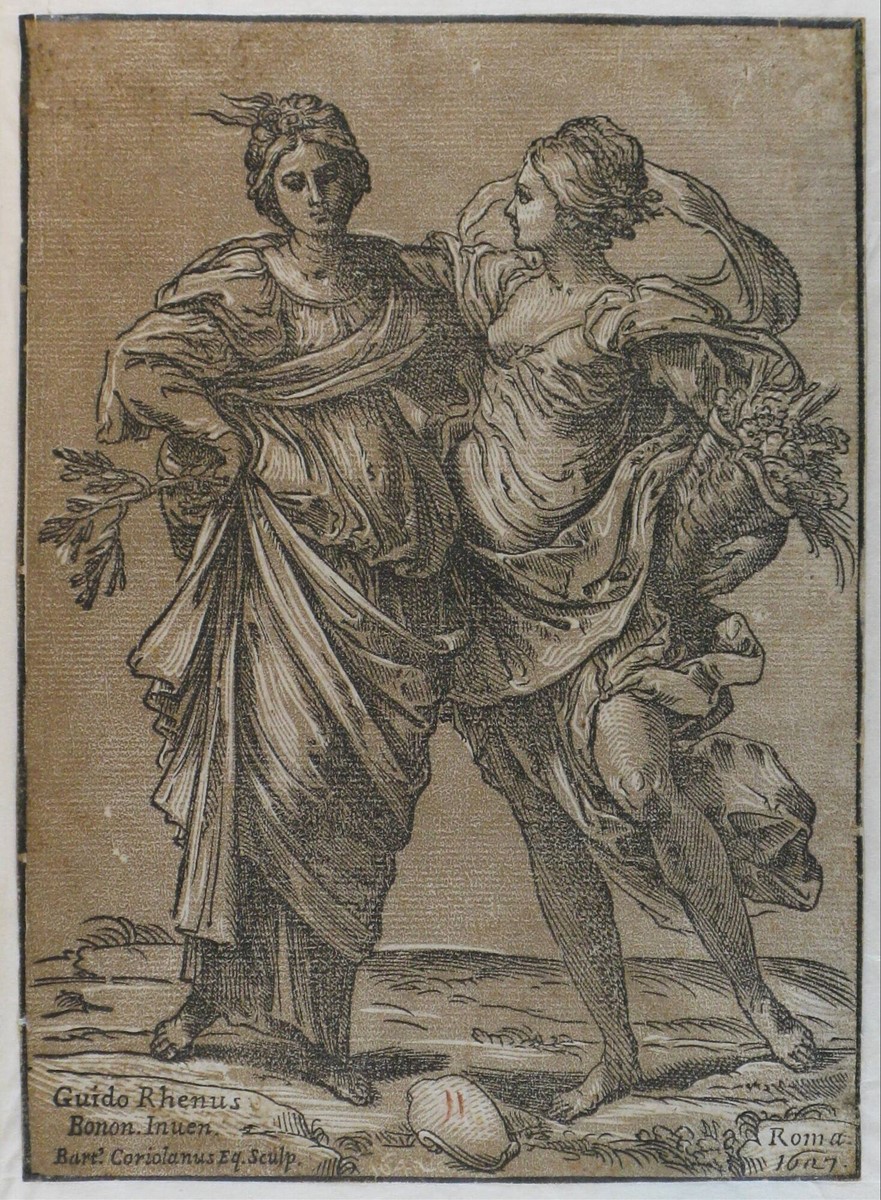
Peace and Plenty

Guido Reni, Peace and Plenty (1627) 
I didn't know that we celebrated the International Day of Peace on September 21st. Is this something new? From what I know facebook participated in the Day of Peace celebrations by making love filled with hearts. I am sure you noticed it, too. Today the heart function is back to normal. Clicking on hearts on Facebook yesterday was much fun!

When I think of peace I envision the etching by Italian artist Guido Reni with the personalizations of Peace next to Plenty. The allegory is meant to express the alliance between the two. To me everything beautiful comes in pairs: peace and plenty is the best example to express this concept that is very often depicted in art. 

Other pairs that come to my mind right now are Venus and Mars, Aurora and Helios, Spring and Hermes. This latter is very interesting with regards to reviving something (spring) as Hermes is the messenger of success. 

Now I have a little story to share. By observing the coat of arms of a local family called Misciattelli, I thought of it as an expression of the alliance of peace and plenty. Colors were reinforcing the idea: blue for the dove's background and red for the cat's. Look at the coat of arms with me:
The Misciattelli coat of arms (colored by me for the Friends of Cama)

The cat was the symbol of the Miscìattelli family because their name comes from 'miscio', onomatopeic for a cat in Italian. The cat is the symbol of abundance as a fat cat means that the neighborhood is feeding him well, that there is food available.  

The dove is the international symbol of peace and the olive tree sprig is an additional element to prove this meaning as true. So when I first saw this coat of arms I thought of being in front of the alliance of peace and plenty again. 

Soon after I asked a heraldic association to let me know if what I thought could be real. I sent them an email. They got back to me and said that coat of arms does not go this far as to allegories. It was just a coincidence. The only thing they said to me is that the dove in a coat of arms is a feminine symbol. 

Indeed what had happened is that the Marquis Misciattelli had gotten married to a local young lady who was invited to select a symbol for herself to be added to the coat of arms on the day of their marriage: she selected the dove of peace. 


Cama® is a lifestyle
                                 
FRIENDS OF CAMA's Blog
Renaissance Art Curiosities in Times of Rebirth   


Cama® is a cultural brand inspired by the Italian Renaissance. Like and share our page to join our online events & receive blog posts. 

NEW! Free Italian arts & crafts consulting by sending a message on the Friends of Cama page


giovedì 15 settembre 2016

FIVE YEARLY WINDOWS FOR TWELVE MONTHS

Simone Martini, Saint Martin of Tours, 1322-1326, Basilica di San Francesco, Assisi, Italy 

My favorite day of the year is New Year's Eve. To me, this day is the first window into my life journey's renewal. Celebrating a new start to the journey with the rest of the world is definitely a great event. 
The egg is a symbol of rebirth and renewal. 

However, there are other important windows during the year. Among all celebrations in Italy, we can list FIVE important occasions to celebrate the yearly revivals: 1. New Year's Eve, Easter, August 15th - also known as 'Ferragosto', November 11th - also known as 'St. Martin's day' and Christmas. Most recently I heard people rename 'Ferragosto': 'Summer New Year's, probably because of the fireworks closing the day's celebrations just like we do on New Year's Eve. 

We are now way ahead towards autumn. Our next yearly renewal appointment is November 11th. In Italy, on this day we celebrate Saint Martin of Tours. The reason is that we remind ourselves of being charitable in order to face the seasons' craziness.

Fireworks in Italy are part of the Ferragosto celebrations
on  August 15th 
These five-yearly celebrations became part of the religious and political calendar in classical ages already- such as the case of Ferragosto, which was the name given to this celebration by Emperor Augustus - Feriae Augusti --> Ferragosto in Italian ---> etymology from Latin: Augustus vacations. However in the beginning these celebrations were part of nature's revival cycles. These cycles were described by the fruits of the earth, among which wheat was indispensable for survival since the dawn of time. Ferragosto was meant to celebrate the closing of the wheat harvesting period. 
Christmas atmosphere in Sicily 


Cama® is a cultural brand on
her revival journey


FRIENDS OF CAMA 


Join the Facebook Page to Receive Blog Updates 

NEW!

Now on Twitter


 Join Cama's Facebook events for a unique armchair traveling experience.  


lunedì 16 maggio 2016

A Discovery About Cortona's Mythological Origins

The town of Cortona originated from a Greek helmet
Last year for the first time in my life I was intrigued by the Etruscans. I had never taken them into consideration, despite the fact that the Etruscans lived in the areas of Umbria where I have lived. What piqued my interest and drew me to the Etruscans was a 3D reconstruction video of a Greek helmet that was found in an Etruscan tomb dated 1st century B.C.

I had this helmet made by a local artisan and I have been wearing it as a lucky charm.
My favorite helmet is housed in the Museo Archeologico
 di Perugia. This helmet was found in an Etruscan tomb

Time passed and in the meantime, I have visited the most important Etruscan museums in my area: Perugia, Chiusi, Corciano and Cortona.

However, only a few weeks ago I discovered something truly amazing about this Greek helmet. According to mythology, this Greek helmet was the origin of the town of Cortona. I have learned these pieces of news by accident by reading a book about Cortona:

"Cortona, mother of Troy and grandmother of Rome" as the ancient proverb goes. Virgil wrote in the Aeneid (III:167, VII:209) that the city was founded by the hero Dardanus, epic son of Jupiter and Electra, who, having lost his helmet during a fight in the Val di Chiana, consulted an oracle. The response left no room for interpretation: Mother Earth had hidden it in her womb because she wanted a turreted and impregnable city - just like the helmet - to rise in that place. It was thus that, obeying destiny, Dardanus built the walls of the new city. Then according to the myth, he went to Asia where his descendants founded Troy. "

After I read this story I like to think that the noble Etruscan whose Greek helmet was found in his tomb was aware of this mythological story, that he had kept this helmet as a treasure in his life and that he wanted it in his tomb as a symbol of eternity.

I hope you enjoyed this story as much as I do. I have shared this story with my archaeologist friend and with an elementary school visiting Cortona. Now happy to share the story with you, armchair traveler friends!

Cama® is a cultural brand on
her revival journey


FRIENDS OF CAMA 


Join the Facebook Page to Receive Blog Updates 

NEW!

Now on Twitter


 Join Cama's Facebook events for a unique armchair traveling experience.  

martedì 19 gennaio 2016

Why these four Italian paintings?


In the United States November 30th, 2015 a Manhattan man of Hebrew and African descent filed a lawsuit "to get white (Aryan) Jesus art taken down" from the Metropolitan Museum of Art in NYC, newspapers report. The paintings subject to the lawsuit are four Italian masterpieces: 1. “The Holy Family with Angels” by Sebastiano Ricci, 2.“The Resurrection” by Perugino, 3. “The Miracle of the Loaves and Fishes” by Jacopo Tintoretto and 4. “The Crucifixion” by Francesco Granacci. These paintings are collectively related as“Racist Artworks”. The consequence of such a view was the man suffering from 'personal stress'. The reason is that Jesus is not faithful to his original race features, "black hair like wool and skin of bronze color". On the contrary, Jesus is painted as a blond-haired man.

The question is: why these Italian Renaissance paintings? After all, the Metropolitan Museum of Art is full of Italian religious paintings, which depict Christ as a white man. Actually, Christ is painted as a white man in Flemish, Spanish, German and French art. Apparently, there's nothing different about them from the other religious paintings in the museum. What do these particular paintings have in common?

Important notice: numbers refer to the original list of the Italian works of art that were mentioned in the man's complaint.
2.“The Resurrection” by Perugino (Italian, Città della Pieve, active by 1469–died 1523 Fontignano), 1502tempera on wood, The Metropolitan Museum of Art, New York


3. “The Miracle of the Loaves and Fishes” by Jacopo Tintoretto  (Jacopo Robusti) (Italian, Venice 1519–1594 Venice), oil on canvas, circa 1545-1550The Metropolitan Museum of Art, New York


4. “The Crucifixion” by Francesco Granacci (Francesco di Andrea di Marco) (Italian, Villamagna 1469–1543 Florence), tempera and gold on wood, circa 1510, The Metropolitan Museum of Art, New York 


It looks like the common feature in the above Italian Renaissance paintings confirms Christ as a blond-haired white man. In addition to the three Italian Renaissance paintings by Perugino, Tintoretto, and Granacci, the fourth painting is a Baroque painting of a lovely Baby Jesus by Sebastiano Ricci. Here Baby Jesus has curly blond hair. That's what we see when we think of angels in Italy: a chubby baby with blond hair. 

1. “The Holy Family with Angels” by Sebastiano Ricci (Italian, Belluno 1659–1734 Venice), circa 1700, oil on canvas, The Metropolitan Museum of Art, New York

Regarding the rest of the paintings, for sure it was in use in the Italian Renaissance to depict people with blond hair as it was a conventional feature for nobility. Indeed in real life noblewomen dyed their hair blond, which was a status symbol for the aristocracy. The only woman thought out with brown hair in paintings is the Virgin Mary. She is rarely blond-haired.

Another important piece of information is that these paintings are located in sections of the Metropolitan Museum of Art that are dedicated to Italian Art. The painting by Sebastiano Ricci is on view in Gallery 619 called 'Venetian View Painting' and part of the general collection of 'European Paintings' to which the rest of the paintings belong, respectively: Perugino (Gallery 603:
Filippo Lippi to Botticelli), Tintoretto (Gallery 607: Venetian Sixteenth-century Painting), and Granacci (Gallery 609: Central Italian Painting of the High Renaissance).

For more information about the above paintings, visit The Metropolitan Museum of Art, New York.

Cama® is a cultural brand 


FRIENDS OF CAMA 


Join the Facebook Page to Receive Blog Updates 

NEW!

Now on Twitter


 Join Cama's Facebook events for a unique armchair traveling experience.  


martedì 12 gennaio 2016

What's the matter with color?

 Carlo Crivelli, Virgin Mary with Child, circa 1480, 
 Pinacoteca Civica Francesco Podesti, Ancona

I am very interested in knowing how the issue about the alleged whitewashed paintings in the Metropolitan Museum of Art will be ending up. I am curious to know how long the trial at the Manhattan Supreme Court will take to get settled. My interest comes from the fact that the four works of art judged as stressful for the American man's sensibility are Italian Renaissance paintings by famous Italian artists. Before any comment could come to my mind, the first thing I did was look for the plaintiff on Facebook and send him a message with a special invitation. A few days later I sent an email to the Met sharing with them the reason why I had gotten in touch with the plaintiff. 

Anyway, this issue brought back to my mind a thought I developed by seeing Italian Renaissance paintings. My thought was reinforced by the Metropolitan Museum spokeswoman Elyse Topalian's statement. She said: “When they were painted, it was typical for artists to depict subjects with the same identity as the local audience. This phenomenon occurs in many other cultures, as well.” 

What I think is that important families in the Renaissance period had their features painted as Jesus Christ, the Virgin Mary, and other saints at least for a couple of reasons: 1. They wanted to be remembered as eternal. It's the game of eternity that keeps all of us out of the picture if we take paintings by the word. Indeed we can refer to Italian Renaissance art with the same terms of communication as most of the time paintings are speaking through rhetorical figures: artists depict a subject expressing something else through metaphors, allegories, and other figures of speech. One of the latest rhetorical figures I have discovered in Italian Renaissance paintings is the so-called 'prolepsis': fruits that tell us about Baby Jesus' destiny as the cucumber represents the resurrection of Jesus. 2. By having themselves painted as religious characters, aristocrats in the Renaissance were keeping them safe from being judged or attacked. They could have these paintings shown in churches and public buildings without arousing jealousy and therefore enemies. The reason for doing this is also that in order not to be attacked we have to go from the general to the individual rather than vice-versa.

I would be interested in finding essays about this subject.  Something scientific about this matter would be highly supportive of this thesis. 

On a more practical level and going back to the American gentleman's legal case against the Metropolitan Museum of Art, I think that one has to take into consideration that the four Italian Renaissance paintings subject to attack belong to our past. They are part of a different period of time than the current one. Therefore the issue is totally anachronistic. Secondly, there is no way we can contrast this attack as there are no works of art belonging to the gentleman's cultural heritage with similar features and about which we could say the same thing. Third but not less important, a work of art's copyright expires if older than 100 years. Therefore the four works of art that the plaintiff wants the Metropolitan Museum of Art to be taken down from their walls have become fully part of our common cultural heritage and deserve to be accepted, if only by way of seniority. 

                                                                    
(to be continued)

Cama® is a lifestyle
                                 
FRIENDS OF CAMA's Blog
Renaissance Art Curiosities in Times of Rebirth   


Cama® is a cultural brand inspired by the Italian Renaissance. Like and share our page to join our online events & receive blog posts. NEW! Free Italian arts & crafts consulting by sending a message on the Friends of Cama page


sabato 2 gennaio 2016

Two Special Italian Renaissance Parents

Raphael's home is nowadays a museum. 
'Urbino: I'd love to see...' is the name of the Facebook event I created a couple of weeks ago to share with the Friends of Cama my upcoming trip to Urbino. I was about to visit Urbino last December for the first time in my life. So I asked my Facebook friends what they wanted to know about Urbino or what they had to recommend that they had liked in Urbino.

My Facebook friends responded with lots of enthusiasm as always. I took notes of my friends' questions and suggestions. I did a small research on the web about a few things regarding some works of art I wanted to see. Then I contacted the local information office about museum tickets. It is no longer possible to enter all museums with one ticket. Admissions to places of interest would have been all separate tickets.

So on Sunday, December 20th I headed to Urbino full of energy to walk around town and visit places. What I noticed is that the town is very well preserved. Downtown Urbino is a Unesco site since 1998. Downtown Urbino is embraced by the Ducal Palace and is also known indeed as 'the town shaped like a palace'. The feeling is like being in the Medieval and Renaissance era.

The plaque dedicated to Raphael on his home in Urbino 
On many downtown residences, plaques are remembering famous people who were born in Urbino, among which the most important of all is Italian Renaissance artist Raphael (1483-1520). Raphael's home was on my list of places to visit in order to answer a specific question coming from a Japanese friend of mine. I wanted to come back from Urbino fulfilling my friend's curiosity.

Upon my arrival, I felt immediately loved. The first place I entered was the church of St. Catherine of Alexandria. Nuns were entering from the opposite doors for their daily hymns and they invited me to sing with them. They handed me their prayers book and I felt honored to participate. What a beautiful welcoming to Urbino. At the end of the prayers, I left the church of St. Catherine of Alexandria and continued on my left. I arrived at the Ducal Palace entrance to the Galleria Nazionale Delle Marche. I passed by several universities, among which the university for foreign languages, as Urbino, is also well known as a university town. However, I left the visit to the Galleria Nazionale Delle Marche as my last visit on the way back to the car.

Raphael, St. Catherine of Alexandria, 1500-1503 Galleria Nazionale Delle Marche,
Ducal Place, Urbino 
This is the summary of the places I visited in order of appearance: 1. Church of St. Catherine of Alexandria 2. Oratorio di San Giovanni 3. Oratorio di San Giuseppe 4. Church of St. Francis 5. Raphael's monument 6. National Art Gallery at the Ducal Palace 7. Cathedral ---> it took me about 6 hours total including a stop at a local restaurant making exquisite 'Crescia', the stuffed local thin and crunchy bread whose tradition goes back to the 15th century.

But...the most important place where I could get some pieces of information for my friend from Japan is missing from my list. It's Raphael's home. Indeed Raphel's home is closed to visitors on Sunday afternoon. It's open 10:00am-1pm only on Sundays. What a disappointment when I found this out. I would never think of such an important place closed on Sunday. However, not everything was lost. At the end of the street where Raphael's home is located up on the hill, I could admire the beautiful monument that was dedicated to Raphael and celebrate the artist's 400th birth anniversary. The Latin writing on three of the monument's sides says Virtuti Post Fata (tr. to excellence after death). Each word is written separately on each side. 

URBINO- Raphael's monument in the gardens overlooking Via Raffaello,
where Raphael's home is located. 
But this is not exactly what made it up for the missed visit to Raphael's home. I wish to share with you the unique discovery that opened up my heart and enriched my visit to Urbino. The last place I visited before meaning to go to Raphael's home is the church of St. Francis. I entered the church just because of the name and inside I found out that Raphael's parents were buried there. So I started searching for the tomb's stone tile. No way I could find it. There were all sorts of noble personalities buried in the church in a couple of rows from the altar to the main entrance door. Kind of hard to read the stone tiles sometimes as benches have been placed over them. However, if I could not read the persons' names I could see a noble family crest. Therefore it was not Raphael's parents. 

I didn't give up and in the end, when checking the horizontal area along with the three entrance doors, almost abandoning my hopes as a large nativity was covering most of the floor, I found out that I had stepped into the tomb when entering the church. Indeed Raphael's parents' tomb is located right at the left entrance of St. Francis church. Raphael's parents were there! 

It was such a moving moment. What an honor for them. What a beautiful homage to Raphael. So I will have to drive to Urbino again to complete my research but I will make sure to pay a visit to Raphael's parents in the church of st. Francis first. That's actually where my next visit to Urbino will start to make sure I won't miss my visit to Raphael's home.  

Joannis Sanctis and Magliae Ciarlae were Raphael's parents. They are buried in the church of St. Francis located near their family home on Via Raffaello, originally Urbino's arts &crafts neighborhood.


Find out more about this post's story on the Facebook event's link ---> stay tuned for my next trip to Urbino with a special tour companion!  

Cama® is a lifestyle


FRIENDS OF CAMA's Blog
Renaissance Art Curiosities in Times of Rebirth   

Cama® is a cultural brand inspired by the Italian Renaissance. Like and share our page to join our online events & receive blog posts. NEW! Free Italian arts & crafts consulting by sending a message on the Friends of Cama page


giovedì 19 novembre 2015

Cake is for CAMA

Etruscan winged horses 
The Cake is for CAMA is the name of the event I created on Facebook about a week ago about my trip to C towns in my area. I had prepared my visit in advance as my purpose was to tour five C towns in one day. However this past Saturday I only made it to Chiusi and Cetona. The five C towns are: Chiusi, Cetona, Città della Pieve, Corciano and Cortona.  So I am dedicating some extra time to completing my visit as planned. So far I have added Corciano to the list. So I am down to three towns out of five. I must say that the trip is getting more and more interesting. Yesterday in Corciano I visited their archaeological museum that was founded in 2009 based on the findings of Etruscan tombs in the area. Indeed I am going to visit the related necropolis one of these afternoons. I have called the family that has the keys to the place and they said they will open the necropolis after 4:00pm for me. The necropolis area is called 'Strozzacapponi'. Knowing that there is an Etruscan necropolis in Strozzacapponi (literally tr. capons' strangler) was an amazing discovery, as I go by this area every time I drive from Piegaro, where I live, to Perugia. What's more interesting is that the family that has the keys to the necropolis owns the supermarket that was built there. In fact, the necropolis was found when excavating for building the supermarket. Isn't that amazing? The necropolis was totally found by accident. From what I can see what these C towns have in common is definitely their Etruscan heritage. In fact, I will be heading to Cortona next to visit their Etruscan museum. Città della Pieve is the closest C town to where I live and I want to go there to see the place where recently new Etruscan tombs were discovered. The place is called San Donnino Poggiovalle.

Chiusi was the first C town that I visited at my event. Additionally, I drove to Chiusi the Sunday prior to my visit. Just in case there was not enough time the day I planned to be in Chiusi to visit their Etruscan tombs. Tombs are located a little outside the town towards Chianciano and it's three of them. We had to make a reservation with a museum guide to visit. Visits are organized by small groups. During the week prior to my official visit to Chiusi for the event, I also visited the Etruscan Museum in Perugia and the Ipogeo dei Volumni in Ponte San Giovanni (Perugia). What was neat about my visits is that I got to talk to the museum janitors. What they all want is more visitors to their places. Museum janitors in Italy may be fine archaeologists, this is also what I found out upon my visits. The ones I talked to are in love with their studies and would like the museums for which they work to receive more visitors.

Cetona is the second C town I visited. I wish to go to Cetona again to visit the Etruscan tomb that is part of a private estate. The area is open to the public a few days a year in August/September. Therefore this is a new appointment for next year. In the meantime, I have accepted the invitation to join a yoga class in Cetona. A special host welcomed me in Cetona the day of my visit and she is a yoga teacher. We had a glass of white wine together sitting outside the local coffee shop and then I headed home for lunch. In Cetona I felt like being in the main piazza in Siena. In fact, the town belongs to the province of Siena. What a great feeling!

So now I have two C towns left to visit: Città della Pieve for its new Etruscan findings and Cortona for its Etruscan Museum. I hope to be back with more news about my Cake for Cama event soon. Thank you for following my journey. It's fun to be in touch. With much fondness, Roberta


"Cake Stands for Cama" is a series of short blog posts
regarding all things I like starting with 'C' like 'Cama'.
I have also thought of adding towns to my favorites list.


Follow me on Twitter and Facebook to receive updates!


martedì 10 novembre 2015

Inspiration Comes When...

One of the landscapes I will be traveling through upon my event on Saturday, November 14th called CAKE IS FOR CAMA


I can feel that moment when I get inspired to write my blog posts. Writing posts is not easy at all. It has to do with something true that is being expressed at the right moment. For me being true comes from establishing enthusiastic connections with friends sharing the same interests and love for something I am experiencing. When that enthusiasm gets to the point of creating something together, that's the best of all. It turns my experience into something beautiful to share with others. That's where the best inspiration comes from.

Additionally while thinking of my posts I have to be careful not to be flattering or try to make other people happy. It does not work. Everything to me in order to work has to be authentic. That's one of the reasons it has taken me so long to get where I have arrived upon my journey with Cama. It all depends on the connections I am establishing upon my revival journey.

I am now busy dedicating time to a follow up to my first traveling event that I have created inspired by the C of Cama. This is something my armchair friends in the world who are in love with Italy will enjoy. If they wish they can participate in the event by interacting with me through questions and feedback about the places I am visiting. Indeed this upcoming Saturday I will be traveling to five different places near where I live whose towns' names start with C like CAMA. Despite this appointment has still being to come, I am already envisioning a follow up to my first traveling event.  The thought of it is boosting my energy.

What's more, is that the action of traveling is very meaningful to me. Basically, I am transferring into reality something I have done in these past years through an ideal journey with Italian Renaissance Art. In this blog, I mostly describe Italian Renaissance Art curiosities and things I like.


Cama® is a cultural brand


FRIENDS OF CAMA 


Join the Facebook Page to Receive Blog Updates 

NEW!

Now on Twitter


Be part of my creative journey. Be part of the change. 

giovedì 29 ottobre 2015

"C is For City"


There are a few small towns in central Italy whose names start with 'C'. I have always thought it would be fun to establish a connection with them. I would start with Cortona, the most visited town by Americans in Italy. It is a very nice place for shopping. Then I would select Città della Pieve which is interesting as a stage and then Chiusi which is easy to reach by train and is a strategic place for a meetup as an example. I have always known Chiusi for its train station in fact. However, I have discovered Chiusi a few weeks ago for its professional ballet school I didn't know of. There is also an archaeological museum that I have planned to visit. Cortona, Città della Pieve and Chiusi are all at hand from where I live and in a small area including three different provinces and two regions: Umbria and Tuscany. I am discovering this area with you as I moved here a few years ago. Italy is like a continent in miniature. You are never done with exploring it. Don't you agree?


"Cake Stands for Cama" is a series of short blog posts
regarding all things I like starting with 'C' like 'Cama'.
I have also thought of adding towns to my favorites list.


Follow me on Twitter and Facebook to receive updates!


lunedì 19 ottobre 2015

'C' For 'CHERRIES'

Fede Galizia (Italian late Renaissance woman artist 1578-1630), Silver compote with cherries and a butterfly, oil on panel, private collection
In Italian we have a tasty tanslation of 'one thing leads to another'. We say 'one cherry leads to another'. The reason for reinventing the word 'thing' for this saying is that in Italian the word thing translates COSA. On its turn the Italian word for CHERRY, ciliegia starts with 'C' and that's where the substitution comes from.

I noticed this interesting curiosity by translating this Italian saying into English. I could not find such an involvement of cherries in English like we do in Italian. So I did a little research. I found out that German and French adopted the Italian saying's literal translation:  'Eine Kirsche zieht die andere' for German and 'Une cerise tire l'autre' in French. Other languages in Europe translated the original Italian saying literally: 'One cherry leads to another', which is so true for cherries. I can't wait for cherries to be back in season. I love cherries!


*****************


This is my second edition  of short  stories entitled "Cake Stands for Cama": stories about my favorites starting with the letter "C".  


NEW!

Now on Twitter