Blog's Translator

martedì 18 ottobre 2016

Interpreting Italian Renaissance Paintings from a Different Perspective

Hans Holbein, Venus and Amor, circa 1524/1525,
Kunstmuseum Basel (The model is the artist's mistress)
I originally meant to write a post about the Renaissance courtesan. It was a topic of interest for me some time ago when I had noticed the distance in terms of quality between the Renaissance courtesans and the nowadays escorts. I wanted to express how everything in the Renaissance period was of a higher level and so I wrote some notes about it. However, I thought that writing a blog post about this comparison was not appropriate and would not take me much further on my journey.  

So I started wondering what courtesan meant in a relationship with mistress and lover. I asked my dear friend Rosemary for confirmation that my supposition about the meaning was correct. Then I waited for more inspiration to write this post and this is what I came up with. I hope you will enjoy it.  

The Renaissance courtesan was in general a very educated woman who could speak foreign languages and was talented in communication, politics, and in the art of love. The  Renaissance courtesan's religious counterpart is St. Catherine of Alexandria, who had the Renaissance courtesan's talents except for being a mistress.  A Renaissance courtesan could never become a saint. However, a Renaissance courtesan, as well as a mistress, could be an artist's model thanks to their beauty.  
Titian, La Bella, 1536, Galleria Palatina, Florence
(The model is often described as a courtesan from Urbino)

An example of a mistress as a model comes from Raphael's Madonna Sistina, which is famous for the pensive angels at the bottom. We have seen these angels reproduced on many popular wall picture decorations in the past couple of decades and they probably are still fashionable. Indeed the Virgin Mary's model is known as La Fornarina, Raphael's mistress.

Raphael, Madonna sistina, 1513-1514, Gemäldegalerie Alte Meister, Dresden, Germany
(the model was known as Raphael's mistress) 
There is much secular life in religious art paintings from the Italian Renaissance period. The secret to me is reading such paintings from a different perspective: which means that most of the time commissioners had themselves painted in the shape of immaculate religious saints so that they could not be attacked by their people.

Such freedom was extended to the artist himself who selected real women from the real world contributing by their beauty to make the paintings eternal. What could be best than celebrating one's own mistress and all the love, story, and emotions involved?

Another point of view is using irony in order to decipher Italian Renaissance paintings. What is refraining us from thinking that the angels at the Virgin Mary's feet are bored and annoyed by the fact that they cannot keep good company with their famous angel friend Cupid?

Last but not least I wish to mention St. Catherine of Alexandria and the triumph of love with her mystical marriage with Baby Jesus. St. Catherine of Alexandria in Renaissance paintings is depicted as a young woman to marry. That's what love is all about when we think of it as a romantic liaison that is celebrated with a wedding. In a way, the woman we see and wish to take to the altar is a symbol of perfection.

One way or the other the Renaissance courtesan, the mistress, and the romantic lover all receive their moment of glory through art.

Parmigianino, Mystic Marriage of St. Catherine of Alexandria, circa 529, National Gallery, London
(The ideal lover for life: St. Catherine of Alexandria)

I wish to thank my friend Rosemary for her contribution to this post. Yesterday I called her Rosemerina, with the endearment I like to use so much in Italian. I often call my American friends with endearments to such an extent that they call me with endearments in return. In particular, they call me FORRESTINA from Forrest Gump, because maybe I do not look that smart but I end up everywhere and get lots of opportunities in life. Go, Forrestina, go!


                                                 FRIENDS OF CAMA 


Like our  Facebook Page to Receive Blog Updates 

NEW!


Now on Twitter
 Join Cama's Facebook events for a unique armchair traveling experience.  


martedì 11 ottobre 2016

"That's Another Pair of Sleeves!"

"That's another pair of sleeves" is a colorful expression that we use in Italian to describe something that is about a completely different thing with no connection to a previous one. The expression comes from the Medieval and Renaissance use of interchangeable sleeves in men's and women's dress in particular.

Agnolo Bronzino, Maria di Cosimo I de' Medici, 1551, Uffizi Gallery, Florence
In Europe, British English provides the expression: "That's a different kettle of fish", while French and other European languages use the idiomatic expression with the sleeves. Other English sayings that are similar to "That's another pair of sleeves" are: "It's a whole new ballgame", "That's a horse of a different color" or simply "It's another thing" and "It's something else", where the else in this idiom means "other than ordinary."

For us in Italy "That's another pair of sleeves" is the expression that to us makes more sense of all the above translations. The reason is that most of the time we use idiomatic expressions by way of tradition without being aware of where they come from. We feel comfortable with using these expressions that our ancestors have used before we did.

We learn idiomatic expressions from our grandparents, our parents, and our community. As idiomatic expressions are often related to arts and history, they can be thoroughly understood only by researching the expression's origin. However, we fully understand what we say without going into the etymology of it. It's the use of the idiom that tells us it is the correct thing to say.

For us in Italy "That's another pair of sleeves" has a positive connotation, probably coming from the beauty of the example it is related to. In terms of comparison of the two things we are mentioning, the second term of comparison is way better than the first one, the best of the two, the right thing.

The interchangeable sleeve tradition in the Renaissance was also part of the lover's cup tradition of giving an engagement token of love to one's beloved for their wedding. Interchangeable sleeves could be so valuable that they were kept in safes.


                                  FRIENDS OF CAMA 


Join the Facebook Page to Receive Blog Updates 

NEW!

Now on Twitter
 Join Cama's Facebook events for a unique armchair traveling experience.  


venerdì 7 ottobre 2016

A Couple More Steps Forward and...It's Paradise!

The Purgatory is the second book written by Dante Alighieri
about a life journey's story. 
The book is part of a famous trilogy called: Divine Comedy
I couldn't wait any longer to share something I discovered on the Purgatory image I posted the other day. The image was part of my blog post about evolution coming in threes. My great discovery is that right now I am close to Paradise. So I am there at the end of Purgatory.

Where do you think I am? You would never ever guess why and where I got stuck these past months in the Purgatory. There is a particular reason you may not aware of. It comes from my family name: Niccacci. I am stuck in the circle of gluttons!!! I only have two circles left and I am stuck with gluttons!

Indeed my last name Niccacci comes from an Italian nickname for glutton, gourmet and to some extent a person who likes the right things, meaning good food as an example and beautiful things. Such a person is defined as NICCA in our dialect. Niccacci is the corresponding noun to 'nicco' (masculine) and 'nicca' (feminine), which are adjectives.

It is such a relief when there is an answer to what is happening to us. In these past months, I have been eating everything that was at hand. The fridge would not open the door for me at a certain point anymore, so much he was tired of being opened every other minute. If only I had known the circle of gluttons was near the end of the Purgatory!

The circle of gluttons is before the last circle. The very last one is the circle of lust. I will skip on that. I will find a rope and climb on it to get to Paradise straight from the gluttons' circle. My great-grandparents, the original Niccacci family, will see me and help me get there with them. They will give me a hand. After all the connection is perfect: from the gluttons' circle to the authentic Niccacci family in Paradise.

I have been waiting to get to Paradise for two years now. Since the time I was in San Francisco in 2014 looking for an eligible partner. A partner I could not find at that time and I was forced to come back to Italy. It was like falling back to square one, to the book of Hell. If people only knew what I have been going through. So once I am in Paradise. I will stay there put and hold on to it!  

Aurora by Guercino: this is ideally what the conclusion of my journey with Cama should look like 

P.s. When I was in school I could not care less about the Divine Comedy. I am enjoying studying art and literature now because they mean something to me. The reason is there is a connection with my real life: my journey with CAMA. Works of art really take life now. They speak to me. I have always loved teaching and with the amazing experience I had in these past years I would have much to share with students:  about the importance of education and how studying could be turned into something useful and enjoyable if we knew what it is for. 


                                  FRIENDS OF CAMA 


Join the Facebook Page to Receive Blog Updates 

NEW!


Now on Twitter
 Join Cama's Facebook events for a unique armchair traveling experience.  

domenica 2 ottobre 2016

Evolution Comes in Threes

Pseudo Granacci, Triumph of Venus, c. 1500, Walters Art Museum, Baltimore, USA


This is purgatory according to Dante Alighieri. A very interesting
critic says Dante's Divine Comedy describes a creative journey.  No  more
struggling in Paradise I hope. Once you get there, you won't feel like
going back.  

One of the things I notice when I watch a movie is that actors try something for three times: the third and last attempt is the right one. This is what usually happens when characters hit a success: the third try is the good one. I am sure you noticed it, too. This happens also in other art productions, as an example in literature. The greatest Italian literary masterpiece, the Divine Comedy, is divided into three parts: Inferno, Purgatorio and Paradiso. The book is inspired by the biblical division of the afterlife: hell. purgatory and paradise. The most interesting critics of the Divine Comedy is that it is the description of a creative path. that means going through three steps that are similar to visiting hell, passing through purgatory and in the end, it's paradise: the celebration of victory. 

But what is a creative path if anything but an evolution journey? This is not all. The reason why I thought of these examples of things coming in threes is that recently I ran into a unique Italian Renaissance altarpiece containing an allegory coming in threes and...expressed by trees! 

The altarpiece with the trees coming in threes is homed in Asolo in the Cathedral of Santa Maria Assunta. It is a masterpiece by Lorenzo Lotto that he painted in 1506 at the young age of 26.  With this altarpiece the artist concluded his art experience in the area of Treviso. 

The trees coming in threes are from the left to the right: laurel,  cypress
and oak. (Virgin Mary altarpiece by Lorenzo Lotto in the
Cathedral of Asolo, Italy)  
In Lotto's altarpiece, three are the trees describing the evolution from redemption (alloro-laurel), death (cipresso-cypress) and resurrection (quercia-oak). I had never seen such an allegory in a painting before. Have you? Do you have any examples to share about evolution coming in threes? Have you ever experienced such a journey in your life?


Cama® is a cultural brand
FRIENDS OF CAMA's Blog
Renaissance Art Curiosities in Times of Rebirth   


Cama® is a cultural brand inspired by the Italian Renaissance. Like and share our page to join our online events & receive blog posts. 

NEW! Free Italian arts & crafts consulting by sending a message on the Friends of Cama page

martedì 27 settembre 2016

Captivity Comes from Captivus


A dear friend of mine from Great Britain recently said to me that once you have learned how to use prepositions in English, you can say you have learned the language. I would like to add that once you are done with prepositions, the next step is using the so-called 'false friends' correctly. False friends are words that are written similarly in English and Italian because they come from Latin and Greek. They are also known as cognates. Indeed whatever word sounds difficult to you in English is easy for us in Italian: basically, all the words that come from Latin and Greek. Many times American and British friends ask me: "Do you understand this word, Roberta?" (As an example: onomatopoeic). And I answer my friends: "Of course, we leant you this word. It's the same in Italian!" 

Why false friends? 

By being away from Italy loan words see their meaning change once they are part of the English language. That is why these words are called 'false friends'. A false friend example is a word 'crisis'. If you read 'crisi' in Italian, we mean 'recession' and not a major catastrophic event. Another false friend is: 'suggestive'. you may run into this word with Italian tour guides who say: 'I invite you to enjoy this suggestive landscape', wherewith 'suggestive' we mean: beautiful, inspiring, unique. That is what the word 'suggestivo' means in Italian. 

However not all words coming from Latin and Greek change their original meaning (i.e. onomatopoeic is the same for both of us). Another word that did not change its original meaning is 'captivity' (cattività in Italian) which is a very interesting word. Captivity comes from the Latin word 'captivus', prisoner. 'Cattivo' or 'cattiva' in Italian is translated as 'evil' in English. That gives us something more important to talk about. 

In Italian the word 'cattivo', 'cattiva' comes from: 'Captivus malii' which means: prisoner of evil. It is much different from saying that a person is evil. In the original Italian and Latin meaning, the person is not evil by nature. The person is a prisoner of evil. That gives us a different perspective when we look at other people. 

'Captivus' is the first Latin word I learned in middle school. The teacher gave us the example of 'Captivus malii'. That is why I remember it so well. I hope you enjoyed my today's contribution. 


"The Unicorn is in Captivity (and no longer dead)" from The Hunt of the Unicorn (ca. 1500), The Cloisters, New York


Cama® is a cultural brand
FRIENDS OF CAMA's Blog
Renaissance Art Curiosities in Times of Rebirth   


Cama® is a cultural brand inspired by the Italian Renaissance. Like and share our page to join our online events & receive blog posts. 

NEW! Free Italian arts & crafts consulting by sending a message on the Friends of Cama page

lunedì 26 settembre 2016

Acanthus Leaves and the Eternal Cycle of Life

Entrance door with acanthus leaves
varieties are seen in Florence 

If you are traveling in Italy you may notice that Italian Renaissance residences, Renaissance-style main doors and gates are often enriched with floral swirls that look like kales, with central flowers and acorns. These details are called rosettes. Rosettes turn a balcony's supporting beams into a festive garland of flowers, an empty door wooden square into a point of attraction. The same artistry applies to paintings and frescoes in the Renaissance: rosettes turn into swirls and explosions of beautiful leaves surrounding a painting's main scene.  

We said we have to keep in mind that the Italian Renaissance was a rewriting of the classical ages. Indeed Italian Renaissance art brought back to life what the classical ages had left us as a heritage.  

We can think of the classical ages as an evergreen remedy in times of revival after a temporary recession or important world phenomenons such as the Industrial Revolution and the current globalization. Indeed these events have much in common because they have given way to the highest consumerism peaks. Consumerism works in pairs with death while artworks in pairs with life. 


Arch of Settimio Severo, 203 A.D., Leptis Magna, Libya


That is why when times are hard on us when we look for a sense in life when we feel lost, we go back to the ages that made us feel eternal. The classical ages are eternal themselves by the means of their works of art and traditions and acanthus leaves are probably the best symbol for eternity. Acanthus leaves carve on Etruscan urns are probably the most meaningful example of the acanthus leaves' message: it's the description of the neverending revival cycle of nature. In this sense, death becomes part of the life cycle and is enhanced and respected the same as life. Acanthus leaves were an invention of the classical ages. They do not exist in real life. They are an idealization of what we strive for: eternity. 
English translation: Antique rosette belonging to
the arch of Settimio Severo (203 A.D., Leptis Magna, Libya)


My curiosity about acanthus leaves comes from the fact that I grew up with my mother Elena painting one of the historic Deruta patterns, called RICCO DERUTA. I started wondering where the pattern came from. Researches took me back to Italian Renaissance artist Perugino.  Then through Perugino, I got interested in the classical ages: Romans, Greeks and Etruscans in particular. These latter are a recent discovery of mine. My love for the Etruscans burst last year only by watching a 3D video of a finding with acanthus leaves carved on it. It was a helmet. It brought me back to the origin of my researches and the circle was concluded. I had found the answer to my question about the meaning of acanthus leaves.

My mother Elena is painting acanthus leaves at CAMA
before 2011.  A classical pattern called: Ricco Deruta


Screenshot from the 3D video reconstructing a helmet with acanthus leaves
that was found in an Etruscan tomb in Tuscany 


Acanthus leave borders from a fresco by Perugino


Cama® is a cultural brand
FRIENDS OF CAMA's Blog
Renaissance Art Curiosities in Times of Rebirth   


Cama® is a cultural brand inspired by the Italian Renaissance. Like and share our page to join our online events & receive blog posts. 

NEW! Free Italian arts & crafts consulting by sending a message on the Friends of Cama page


giovedì 22 settembre 2016

Peace and Plenty

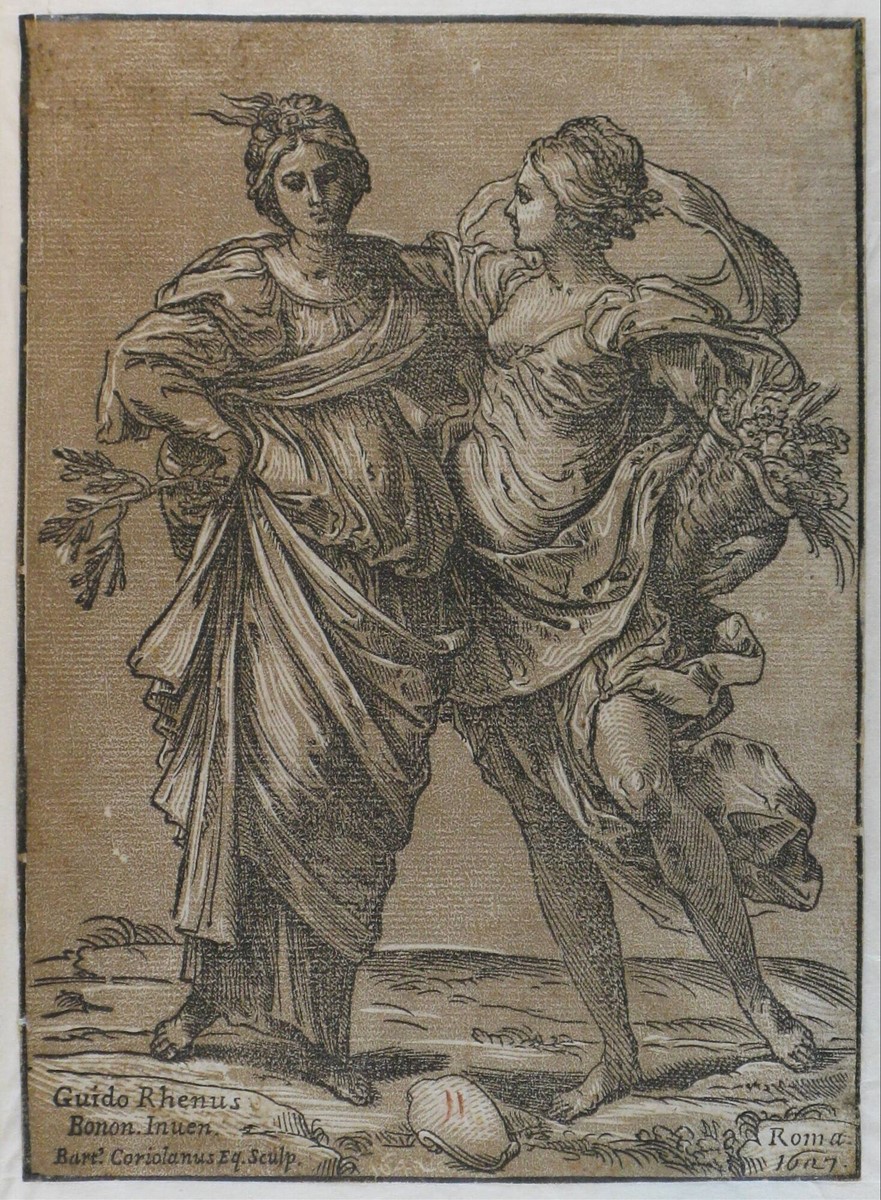
Guido Reni, Peace and Plenty (1627) 
I didn't know that we celebrated the International Day of Peace on September 21st. Is this something new? From what I know facebook participated in the Day of Peace celebrations by making love filled with hearts. I am sure you noticed it, too. Today the heart function is back to normal. Clicking on hearts on Facebook yesterday was much fun!

When I think of peace I envision the etching by Italian artist Guido Reni with the personalizations of Peace next to Plenty. The allegory is meant to express the alliance between the two. To me everything beautiful comes in pairs: peace and plenty is the best example to express this concept that is very often depicted in art. 

Other pairs that come to my mind right now are Venus and Mars, Aurora and Helios, Spring and Hermes. This latter is very interesting with regards to reviving something (spring) as Hermes is the messenger of success. 

Now I have a little story to share. By observing the coat of arms of a local family called Misciattelli, I thought of it as an expression of the alliance of peace and plenty. Colors were reinforcing the idea: blue for the dove's background and red for the cat's. Look at the coat of arms with me:
The Misciattelli coat of arms (colored by me for the Friends of Cama)

The cat was the symbol of the Miscìattelli family because their name comes from 'miscio', onomatopeic for a cat in Italian. The cat is the symbol of abundance as a fat cat means that the neighborhood is feeding him well, that there is food available.  

The dove is the international symbol of peace and the olive tree sprig is an additional element to prove this meaning as true. So when I first saw this coat of arms I thought of being in front of the alliance of peace and plenty again. 

Soon after I asked a heraldic association to let me know if what I thought could be real. I sent them an email. They got back to me and said that coat of arms does not go this far as to allegories. It was just a coincidence. The only thing they said to me is that the dove in a coat of arms is a feminine symbol. 

Indeed what had happened is that the Marquis Misciattelli had gotten married to a local young lady who was invited to select a symbol for herself to be added to the coat of arms on the day of their marriage: she selected the dove of peace. 


Cama® is a lifestyle
                                 
FRIENDS OF CAMA's Blog
Renaissance Art Curiosities in Times of Rebirth   


Cama® is a cultural brand inspired by the Italian Renaissance. Like and share our page to join our online events & receive blog posts. 

NEW! Free Italian arts & crafts consulting by sending a message on the Friends of Cama page


giovedì 15 settembre 2016

FIVE YEARLY WINDOWS FOR TWELVE MONTHS

Simone Martini, Saint Martin of Tours, 1322-1326, Basilica di San Francesco, Assisi, Italy 

My favorite day of the year is New Year's Eve. To me, this day is the first window into my life journey's renewal. Celebrating a new start to the journey with the rest of the world is definitely a great event. 
The egg is a symbol of rebirth and renewal. 

However, there are other important windows during the year. Among all celebrations in Italy, we can list FIVE important occasions to celebrate the yearly revivals: 1. New Year's Eve, Easter, August 15th - also known as 'Ferragosto', November 11th - also known as 'St. Martin's day' and Christmas. Most recently I heard people rename 'Ferragosto': 'Summer New Year's, probably because of the fireworks closing the day's celebrations just like we do on New Year's Eve. 

We are now way ahead towards autumn. Our next yearly renewal appointment is November 11th. In Italy, on this day we celebrate Saint Martin of Tours. The reason is that we remind ourselves of being charitable in order to face the seasons' craziness.

Fireworks in Italy are part of the Ferragosto celebrations
on  August 15th 
These five-yearly celebrations became part of the religious and political calendar in classical ages already- such as the case of Ferragosto, which was the name given to this celebration by Emperor Augustus - Feriae Augusti --> Ferragosto in Italian ---> etymology from Latin: Augustus vacations. However in the beginning these celebrations were part of nature's revival cycles. These cycles were described by the fruits of the earth, among which wheat was indispensable for survival since the dawn of time. Ferragosto was meant to celebrate the closing of the wheat harvesting period. 
Christmas atmosphere in Sicily 


Cama® is a cultural brand on
her revival journey


FRIENDS OF CAMA 


Join the Facebook Page to Receive Blog Updates 

NEW!

Now on Twitter


 Join Cama's Facebook events for a unique armchair traveling experience.