Blog's Translator

Visualizzazione post con etichetta Piegaro. Mostra tutti i post

venerdì 21 settembre 2012

Grifonetto Baglioni: the most handsome nobleman of his time in Perugia

A new coffee shop has opened in Piegaro and it is called
"BAR LUNA" from the name of the owners' cat: LUNA! 
This year in August new ownership took over the coffee shop on my street and the name seemed already a good omen: BAR LUNA. It is not much about the moon but rather the fact that it is named after the owners' cat and Piegaro is the town of cats!

As an example my home's karma turned out to be cats without knowing it, there are images of cats everywhere including a wind-chime (all things that came with the home and I rearranged), what I brought in was the painting of birds in cages, which at this point is very safe for them to be in. I am very happy for these birds, I will find a way to make them feel free out of the reach of cats.

So in Piegaro, there are many beautiful cats, a few of them stand out, as an example 'Nuvola' who is the hostess of Piegaro. Recently there was a new entry, a tabby cat who was abandoned by his owners in the parking lot below the village. He made his way up to downtown by taking the stairs, leaving his water container behind and the first home he found became his new home. He seemed to be very well-fed, healthy, and friendly. He had no problem adapting to his new life. Last but not least an expat cat arrived recently in town and is named 'Mishka', he speaks Russian, Norwegian, English, Italian and Cat and he seems to be pretty comfortable with the rest of the community of cats in Piegaro. After all, he must be very educated with all his travels, he must have gotten over the fear of others. Finally, there is another cat who acts like a dog, I think he emulated dogs at a certain time in his life, he sits next to the bench where his owners are sitting as if he were a dog and he follows them along the streets of Piegaro just like a dog. I have loved cats all my life but cats in Piegaro surprise me every day. Cats in Piegaro are special cats or they become special by living here.

The Ghripon is the Symbol of the town of Perugia. 'Grifonetto'  is a term of endearment that comes
from 'Grifone', we use terms of endearments a lot in Umbria. Words usually end with -ino, -ina, -etto, -etta
Piegarese celebrate with
"Prosecco" wine, my fiancé has
introduced me to Spritz, a
classical drink from Veneto,
based on Prosecco with Aperol
drink and sparkling water.
"Cin-Cin!" "Salute!"=
"Cheers!"
Going back to the BAR LUNA, the owner of the coffee shop is very professional in what he does, he knows what he is doing, he has worked for many years for famous coffee shops downtown Perugia, he is a traveler and he has also worked as a chef but he says he prefers serving at the coffee shop because he likes to be with customers. I got very interested in his way of interacting with people, he is originally from Perugia and knowledgeable about the history of Perugia. At first, I said to myself that I had met one of the few perugini who are "simpatici", perugini are known for being "antipatici", unfriendly, snobbish, and to some extent rude (deriving from a prejudice), they are known to be bold, as per the description of Pope Paul III who had a strong fortress built in the city of Perugia in order to contain the boldness of the Perugini, in Latin: "ad coercendam Perusinorum audaciam". What makes the difference with other Perugini is that this gentleman is very open to listening and easy in responding!

Therefore between one espresso and the other, an excellent croissant -freshly made by a famous pastry shop in Perugia (that I love)- and a blackberry fruit juice, sometimes a Spritz with my fiancé, we started making friends by going back historically, beyond our short lives, funny enough from the Renaissance time of Perugia. Now I do not recall why he happened to introduce me to a gentleman of the Baglioni family of Perugia, Lord Grifonetto Baglioni. Grifonetto, locally called "Il Grifonetto" was apparently the most handsome nobleman of Perugia. I didn't know about his existence and his story but as soon as he mentioned a famous altarpiece painted by Raphael, I got more and more interested. This painting was originally commissioned by Lady Atalanta Baglioni, Grifonetto's mother, in 1507 and the face of Jesus is the authentic face of Grifonetto, Jesus is the handsome Grifonetto Baglioni.


Raffaello Sanzio, Raphael, painted this altarpiece for the Baglioni
family in Perugia in 1507 upon order of Lady Atalanta Baglioni, Grifonetto's mother.
(Borghese Gallery, Rome). It is called Baglioni Altarpiece (this is the central piece of the original work of art
now scattered in three museums)
The oil painting on wood was originally placed in the Church of San Francesco al Prato at the end of Via Dei Priori downtown Perugia, where it remained for about a century and later transferred to the Borghese Gallery in Rome. This painting was very important for the career of Raphael, it opened him the gates to Rome, where he was invited the following year by Pope Julius II.

Apple green is currently the color to go for
wedding decorations in Italy, such as favors.

While the altarpiece meant glory and success for Rapahel (1483-1520), one of the greatest artists of the Italian Renaissance and apprentice of Pietro Perugino, the story of the painting is very tragic, there is the grief of a mother for the loss of her child (expressed by the Virgin Mary and the rest of the characters as well as by the cloudy weather), Atalanta Baglioni's handsome son Grifonetto, who had been murdered following to internal fights in the Baglioni family for the supremacy of a branch of the family and which go under the name of "Nozze di Sangue" or "Nozze Rosse" (tr. blood nuptials or red nuptials) and that took place on July 15th, 1500.


Among historical memories and lots of enthusiasm for Piegaro and my new friends, Luca and Patrizia at Bar Luna, I have already organized with them the sale of subscriptions for the jogging competition that will take place on September 23rd, this Sunday, in favor of the local cancer association (they sold out!). The next project is Zumba lessons. Bar Luna is going to find a Zumba teacher in Perugia, who is willing to come to Piegaro to keep us healthy! I will add some advice about eating healthy food and will ask advice to Bar Luna, maybe we can throw a health party at their café!


-------------------------------------------------------------------------------------------
BAR LUNA  VIA ROMA, 15 -  06066 PIEGARO (PG) open every day.

-----------------------------------------

- Original Posts by Roberta Niccacci -

FRIENDS OF CAMA 
Join the Facebook Page to Receive Blog Updates 

NEW!

Now on Twitter

martedì 18 settembre 2012

Little Paris: The Art of Welcoming

Pope Paul III portrayed by Titian in 1543 at the
age of 75. 


Celebrating an important event that took place in Piegaro on September 20th, 1547, welcoming Pope Paul III who enjoyed staying in Piegaro.
-----------------------------------------------------


Last year in January I moved to the village of Piegaro on the border between Tuscany and Umbria. In my small house at the town entrance, which was once the toll house for all merchants entering the main door, I spend my days working on my research and enjoying learning about Italian Renaissance art and history.

The red area is the Piegaro municipality, the blue area
is the Deruta territory. In the Renaissance
period, Piegaro was an "Estate" and Deruta was
a "Castle". 


I selected Piegaro by accident because I am renting from one of my best friends and he happened to have a home for rent in Piegaro. What I knew about Piegaro was that there was a famous glass factory organized as a cooperative (I love cooperatives) and an American lady I knew the existence of from Slowtravel, she had remodeled the most ancient glass factory of Piegaro by turning it into a villa with apartments and she wrote on Slowtravel.
Little by little the town of Piegaro became very meaningful to me because it is located near Città della Pieve, the hometown of the artist Perugino. I imagined the artist on his horse riding to Deruta, which was a town of interest for very important family members in the Renaissance period such as the Borgias, the Sforza family, the Farnese family, and the Medicis along with the Baglioni's, owners of the castle of Deruta. Pietro Vannucci known as Perugino was a major artist of that time. He inspired the ceramic tradition immensely, besides painting a famous fresco for the castle of Deruta.

In the Church of St. Silvester in Piegaro
the chandelier in front of the altar was made in
one of its glass factories. 

So the first person I contacted when I arrived in Piegaro was this American lady, by email because in the month of January she was in the United States. Then I started exploring the town and found out that people were extremely welcoming!

the cathedral of Orvieto's glass windows
were made in Piegaro. In this
window:
"St.Paul with Angels"
Until the 1960s Piegaro produced
this kind of bottle called
"fiasco". Straw was
applied by hand. 
Indeed the piegarese are very cheerful and friendly, treasurers of a tradition of glory thanks to the glass factories which have been part of their culture since the 13th century with different productions. They are used to receiving people for the glass factories business, for travelers stopping by and from the fact that many piegarese expatriated and eventually came back to their land of origin, attracting people from the places they had lived in. Last but not least Italians and foreigners have been selecting Piegaro as a favorite place to move in and some of them have contributed to enhancing the town experience.
For a certain period of time in more recent years, specifically in the 1960s, Piegaro was called "La Piccola Parigi" (tr. Little Paris), because its downtown area was full of small selected stores with many different artisans, of social life traditions such as early evening promenades, which were a must for the married couples of Piegaro. The town was more lively than ever reaching its highest peak from the Renaissance times.
                                                                       
In my recent readings about Piegaro, I discovered that the welcoming tradition belongs to the history of Piegaro itself and it is also witnessed by a very refined and distinguished person, Pope Paul III (1468-1549), a member of the Farnese family in Rome, born Alessandro Farnese. Pope Paul III visited Piegaro five times on his way from Rome to Perugia and he was delighted by the place and its people. Pope Paul III is remembered as one of the greatest patrons of the arts of the Renaissance period, he was in touch with very important artists such as Titian and Michelangelo; to this latter, he commissioned the Last Judgement and the Capitol Square in Rome. Paul III is remembered as one of the greatest Popes of all time.
The modern glass factory in Piegaro has
specialized in making bottles for
famous companies such as Martini.
In the book "Storia di Piegaro e delle sue vetrerie" (tr. history of Piegaro and its glass factories, 1976) by Senofonte Pistelli we may read the story of Pope Paul III visiting Piegaro and this is a summary of it: 


"Pope Paul III visited Piegaro for the fifth time in 1547 and within that occasion, he wanted to thank the Piegarese for their affectionate welcoming and the warmth they expressed towards him by giving them three gifts: the wall clock for the Church bell-tower, secondly the exemption from a tax called "Gabella dei quattro Piedi" (tr. duty of the four feet) for the 18 years to follow and finally Pope Paul III proclaimed Piegaro "Terra" (tr. Estate), the highest title for a town at that time. Piegaro was honored with these presents on September 20th, 1547. Pope Paul III died two years later but Piegaro remained in great consideration at the Roman Curia."


Lucretia Borgia was among the visitors of the
Castle of Deruta. According to history, she
had blue eyes and dark hair (brunettes used
to dye their hair blonde at that time, a tradition that
we still have in Italy). This is a rare painting with Lucretia's
original hair color.


Renaissance wall plate with the writing:
"La Giulia Bella" (Giulia The Beautiful)
16th Century - namely Lady Giulia Farnese.
 (Deruta Ceramics Museum)


Ceramic wall plate with the Farnese Family Coat of Arms,
namely Pier Luigi Farnese, and made in Deruta (A.D. 1537). 


Farnese
Coat of Arms

Pope Paul III had a famous sister, Lady Giulia Farnese (1474-1524), known as "La Giulia Bella" (Giulia the Beautiful). Giulia Farnese was a friend of another famous lady of the Renaissance period, Lady Lucrezia Borgia, who is mentioned among the visitors of Deruta. Indeed at that time a  famous wall plate with the writing "La Giulia Bella" was produced in Deruta and is part of the collection of the Deruta Ceramics Museum. 


Additionally at the Deruta Ceramics Museum we may notice a commemorative wall plate with the Farnese Family Coat of Arms and dedicated to the election of Pier Luigi Farnese as Duke in 1537. The reason why members of papal families were visiting Deruta may rely on the fact that during the so called "Salt War" of 1540 between Perugia and the papal states, Deruta stand for the Pope, thus ending the dominion of the Baglioni family in our town. In Deruta as a consequence of this war we have been using unsalted bread since that time as well as they do in Piegaro. 


---------------------------------------------------------------------------------------------------

Notes: "Terra" (Estate) was the highest title out of three: 1. Terra (Estate), 2. Castrum (Castle), 3. Villa (Village). "Gabella dei Quattro Piedi": Tax of the four feet apparently refers to a length unit= 1 'piede' ('pes' in Latin)=0,2957 m. 


----------------------------------------
Original Posts by Roberta Niccacci -

FRIENDS OF CAMA 
Join the Facebook Page to Receive Blog Updates 

NEW!
Now on Twitter

lunedì 3 settembre 2012

RIDING THE HORSE - DIRECTION: DERUTA

The votive offering was painted by Perugino for the community
of Deruta (1477-1478). The plague was over in the town.
Saints Rocco and Romano were considered anti-pestiferous.
(Deruta Painting Gallery, originally in the Church of Saint
Francis in Deruta) 
The castle of Deruta in a ceramic plaque of the 1940s  (photo by Roberta Niccacci)

If you are in the  Piegaro - Città della Pieve - Fontignano area you might think of yourself as belonging to the flourishing Renaissance history of Deruta; by accompanying Maestro Pietro Vannucci known as "Perugino" (1448-1523) from Città della Pieve to Deruta in one of his trips to the town of ceramics.
This great artist of Italian art history was born in Città della Pieve and died in Fontignano, where he is buried. Perugino was one of the most important local and famous artists who inspired the ceramic art of Deruta, together with Bernardino di Betto known as "Pinturicchio" (1452-1513).
Between 1477-1478 the community of Deruta commissioned Perugino a votive offering (that we call "ex-voto" using the Latin expression) as a thank you for the end of the town's plague. This is one of the reasons why Perugino came to Deruta often, painting his fresco for the town of Deruta.

Also during the Renaissance period, Deruta was a famous place for VIPs such as the Borgia and Sforza families, artists, merchants, and bankers.

Detail of a fresco by Perugino from the "Nobile Collegio
del Cambio" in Perugia (money exchange office)
Deruta ceramic artists took their inspiration
from this hat's floral swirls as an example. 

At that time according to available literature, there were about ten ceramic workshops, churches, a hospital for pilgrims, and a few banks with a population of about one thousand Derutese.

Reproduction of a ceramic pitcher
from the origins of the history
of ceramic in Deruta. 
In the same years Perugino worked in Deruta (1477-1478), elegant ladies used to come to Deruta and visit the castle which was a property of the Municipality of Perugia. Indeed in the late 15th century and in the 16th century, Deruta became famous for creating decorative floor tiles for Churches and Chapels. Examples are the "Cappella Bella" (beautiful chapel) in Spello, namely for the Baglioni Family, nobles of Perugia, and the benedictine Church of Saint Peter in Perugia.

Detail of a Deruta handpainted wall plate from a fresco by
Pinturicchio. The writing is in Latin: "Ab Amicis Iusta
et Honesta Petamus" (tr. Don't ask your friends too much)
by famous Latin writer Cicero.
Deruta ceramic history probably started in the late 13th century. The first document witnessing a delivery of pitchers to a convent in Assisi goes back to 1282, which is a very recent discovery. The tradition definitely started in Deruta thanks to the availability of clay on the banks of the river Tiber, which runs in the town outskirts as well as the availability of woods on the hills over Deruta, necessary for furnaces. The art of ceramics itself probably came from the influence of Etruscan and  Roman cultures. Rome in particular was specialized in accessories for the table and its ceramicists worked at that time along the river Tiber's banks.

Handpainted Reproduction of the famous work of
art by Leonardo da Vinci "Lady with an Ermine"
(By Romano Ranieri)
In the origins, colors in use were only a few: green and manganese on white glaze. In town, there are a few studios that still do faithful reproductions of this style considered as sort of rustic compared to the Renaissance style productions.

Indeed with the passing of time, the ceramic tradition evolved to more elaborate designs which are distinguishing Deruta. Namely creating historical drawings such as the"Raffaellesco" and "Ricco Deruta" patterns; with a wide palette of colors from blue to yellow, orange, rust, green and red. Inspired by Renaissance talented artists they started reproducing scenes, profiles, and decorations into ceramic pieces, imitating the noble art of frescoes.
A second Renaissance period of Deruta ceramics dates back to the 1920s, thanks to the passionate research of the savants of the town of Deruta. The tradition came back to life towards the end of the 19th century after a long period of absence as a consequence of the Industrial Revolutions.
The original painting by Leonardo da Vinci,
"Lady with an Ermine" (about A.D. 1490) 
Latin was the language in use in both Renaissance periods and also in use nowadays for important writings on decorative plates, show plates, and decorative home accessories.

Saint Catherine of Alexandria is the Patron Saint of Deruta ceramicists and is celebrated every year on November 25th. Her symbol is the wheel, known as Catherine's wheel:  Deruta is famous for round shapes and terracotta's most production is made on the kick wheel. This is what Deruta is famous for and why this Saint is so meaningful to ceramic artists.

Rue on top of the
tower.  this is where
the name Deruta
comes from.
Detail of the crest 
of Deruta 
Deruta ceramics go under the name of "majolica" or simply "maiolica". "J" in Italian is an old-fashioned way of writing "i", no longer in use... More information and curiosities are in this blog. Follow www.friendsofcama.blogspot.it, like my Facebook page to receive blog updates!


p.s. Piegaro is about 40 km away from Deruta by car, an estimate 50 minutes drive.


-----------------------------------------

- Original Posts by Roberta Niccacci -

FRIENDS OF CAMA 
Join the Facebook Page to Receive Blog Updates 

NEW!

Now on Twitter

domenica 22 luglio 2012

Recycling and Reusing as a Renaissance Art


Recycling bottles of different colors and shapes

In Rome last week Piegaro won a very important reward for being the best in Umbria for recycling along with Torgiano (home of the Lungarotti wineries), Fratta Todina (originally a Florentine Medieval castle),  and Giano dell'Umbria (founded by the Romans on the famous Via Flaminia, leading from Rome to the province of Rimini). In Umbria we have a total of 92 municipalities, therefore we think of this prize as a very important reward. 


The Crodino payoff  goes:
"L'analcolico biondo che
fa impazzire il mondo"
(tr. "the blonde soft
drink that turns the world on")
was invented in 1964.  It is
a best seller in Italy.
One of the reasons for recycling glass in Piegaro is that here there is one of the largest glass factories in Europe producing up to 3 million and a half bottles a day for well-known companies such as: Campari (their famous  "Crodino" is the best selling non-alcoholic beverage in Italy),  Martini ("No Martini, No Party" is the line of the famous Italian TV commercial starring George Clooney),  vinegar producers, olive oil producers, wineries. Check the bottom of a glass bottle wherever you are in the world, look for the raised acronym "Vcp" (as well as "Vbd", with the "V" written exactly like a square root symbol). Your bottle was made in Piegaro, Italy! 

VCP stays for "Vetreria Cooperativa Piegarese" (Piegarese Glasswork Cooperative) and was founded in 1960. Last year the glass factory celebrated 50 years of success of their 180 partners. In the beginning partners were only a few brave workers who decided to go for the change. I am personally a fan of cooperatives and to me they would be wonderful management solutions for small companies in Italy now to recover from their temporary recession. We would keep our traditions alive and workers would not lose their jobs. Partners in a cooperative all have the same shares and their monthly wages (in Italy workers are paid by the month) depend on the job they do in the company. They have the same rights of other workers of equal fields. 


Example of a Murano glass chandelier.

VCP is a modern evolution of the local glass blowing tradition. Glass blowing art came from Venice and settled in Umbria through the Benedictine friars around 1293 A.D. In the church of St. Silvester in Piegaro there are two beautiful examples of  glass chandeliers: one made in Piegaro before the 1960s and one recently made in Murano, Italy, where the Venetian tradition is still alive. This latter a donation of a Piegarese family to the church. This chandelier was purchased in Venice, because the original tradition in Piegaro has evolved over the years to serve the market of bottles passing through flasks and currently producing industrial bottles. 

Nowadays modern glassmakers in the VCP glasswork factory check computerized kilns, glass cooling machineries and make sure that the automated palletizing machine is doing everything correctly. Quality check-up is  made by visual control and by very advanced computers that can spot defects and discart defective pieces.  They think of the bottle as a person and scan the bottles' mouth, neck, shoulders and body. 

Glass traditionally comes in two colors: green and clear white. The highest percentage of recycling is green because of the highest usage in homes compared to white glass ( green is about 90% recycled glass, white is about 30%). 


A super model of Renaissance times:  blonde Venus by Botticelli
painted between 1482-1485.  A very modern example of beauty, a long lasting
model of perfection. 
It is interesting to notice that art critics use the term "recycling" and "reusing" to express a Renaissance concept. 

Indeed the Renaissance period imitated latin and greek classics in style, excellence, virtue and example. Renaissance artists created new art products that revived the Italian cultural heritage and kept traditions alive by the usage of perfect classical models. 

The founding system of recycling models  in the Renaissance period was called "imitatio" (tr."imitation") and we may find this practice in arts, politics, social relationships and individual virtues (=the art of doing things well).  Imitation was based on classical rules which let groups of artists share life and work experiences with their ancestors'  pace and wisdom

Later on the concept of "imitatio" was reinforced by the idea of "aemulatio" (tr."emulation") which provided a list of technical requirements to different fields - arts, politics, literature - leading to a universal system that lasted in Italy until the Romantic period.  


Art bottles by Paolo Venini (1895 – 1959)


-----------------------------------------

- Original Posts by Roberta Niccacci -

FRIENDS OF CAMA 
Join the Facebook Page to receive Blog Updates 

NEW!

Now on Twitter


martedì 5 giugno 2012

RUE: THE HEALING HERB OF DERUTA


Memories of Deruta and Good Luck 
symbols 

The herb of the Rue still grows on the city walls of Deruta and has given the name to the town, according to a disregarded theory. 
Renaissance symbols in contemporary times
found in the hot spot of Piegaro, Italy: "Bar Fortuna",
Fortune Coffee shop.  

I thought of Deruta this morning at  "Bar Fortuna", the hot spot of Piegaro, where they serve a "grappa" from Northern Italy made by the distillation of the rue. Rue is a diffused herb of Deruta, whose original name in Latin is  "RUTA GRAVEOLENS", as per the label on the bottle

"RUTA GRAVEOLENS" is the original Latin name of the RUE, Grappa is a fragrant beverage that the Venetian glass
makers brought to Piegaro with their glass tradition in the late
13th century. 
I like to think that the name Deruta comes from "Rue", "RUTA" in Latin, "DE-RUTA".  "DE" in Latin is a preposition that can translate many meanings, among which  "as per imitation of". "Imitating" the herb of the rue would express that a town is a healing place, as much as rue was considered an anti-pestiferous herb in Renaissance times. 

Other meanings of "DE" are: from, out of, about. Regarding the origins of the name DERUTA, my question is: why would the rue be on top of the tower of the crest of Deruta if the rue had nothing to do with it? I am asking this question because I keep reading about the origin of the name DERUTA coming from 'destroyed', "disrupted'.  
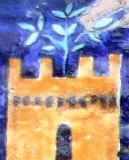
The ceramic Crest of Deruta (the photo is mine)
Indeed as regards the heraldry, if we analyze the crest of Deruta, we notice three elements representing the town's symbols: 
1. a Tower, symbol of the castle of Deruta;
2. a Griffin, homage of the town of Perugia to Deruta;
3. a plant of Rue on top of the tower. 

The plant is also a symbol of good luck (tr: "Fortuna"). Rue is one of my lucky charms and I have used it as a miniature on this blog's flap. 

the detail of the rue
on top of the tower of
Deruta

The stylized flower of rue
as a lucky charm in the
hands of the Queen of Hearts.


Going back to the "grappa" with rue leaves and sprigs,  it is curious to notice that the glass bottle is plain white, it is the rue that gives it a vibrant green color that is difficult to reproduce in the picture. And which other color is the symbol of good luck besides green? Green!

When I first took the photo the bottle was brand new and sealed. Rue grappa tastes really good. It tingles a little.
As lucky charms are concerned, a theory states that the flower in the hands of the Queen of Hearts is a blooming flower of rue.


My latest discovery is that the word "Rue" "Ruta" comes from Greek and means "liberation", "redemption". Recently I am drawn to this word so much. I just love it! 


-----------------------------------------

- Original Posts by Roberta Niccacci -

FRIENDS OF CAMA 
Join the Facebook Page to Receive Blog Updates 

NEW!

Now on Twitter


lunedì 11 luglio 2011

Lost crafts: The Art of Straw Weaving in Piegaro

FIVE "fiascos" from left to right:
1. An old fiasco I found in the home I live.
2. The fiasco I bought in the Piazza of Piegaro from Peppina.
3. 4. 5. The fiascos I made at the classes of straw weaving! 

News From Piegaro, Italy - The art of straw weaving around the bottle called a "fiasco" belongs nowadays to volunteers promoting the town upon appointment of the cultural association "Il Borgo". Artists give free demonstrations to tourists in the Piazza in the evenings and for 5 euros you can take a "fiasco" home with you. The association "Il Borgo" gives all the revenues from the sales of these“fiascos” to the promotion of the art of straw weaving in Italy and abroad. It is also possible to take lessons at the local Glass Museum for the same price! 

Herewith follows a description of the art from the files of the Glass Museum in Piegaro: 

"Flask production is associated  with specific workmanship, called dressing, entrusted up until the 1970s to Tuscan straw-workers of Castelfiorentino, Certaldo, Montelupo, Empoli and Colle Val D’Elsa, and to flask dressers of Piegaro who used sun-dried marsh plants (scarcia).

At first, straw work was done inside the glasswork factories. Then, because of increased production, the containers were taken to the dressers’ homes. This activity served to supplement the modest domestic budget, or even maintain it completely, especially in moments of crisis. The women used to do piecework, for very long hours, often even after supper and on Sunday morning. They would work seated on little stools since this enabled them to hold the flask better.

Technique and Instruments

The scarcia was always kept soaked in water so that it would not break when used and would not cut the worker’s hands. When there was an urgent consignment, the women organized a work chain, leaving the best dresser to finish off the work […].

The only instruments used in this craft were often passed down from mother to daughter and included needles of various shapes and sizes, and a pair of scissors. The plants used to obtain the sala or scarcia were picked on the banks of the lakes or marshes. The scarcia was also used for the padded parts of the chairs.
fiasco on the left: binding technique,
fiasco on the right winding technique,
 classical of Piegaro.


The two most common working techniques were binding, where leaves of scarcia were inserted vertically between the base and the shoulder of the flask, and winding, which was used to cover a certain type of flask, the pulcianella, in which a cord made of interweaved leaves started at the base of the flask and was wound round up to the shoulder. A short cord was added to the finished flask to make it easier to carry when holding more than one container in the same hand".

(Credits: from the leaflets of the Glass Museum in Piegaro).

************************************************************************
Your staying in Piegaro: Visit the website of my friends Colleen Simpson and Tom Webb, owners of L'Antica Vetreria:  the first glass factory in Piegaro from the 13th century is now a beautiful Villa! www.anticavetreria.net

giovedì 25 novembre 2010

1861- 2011: 150th Anniversary of the Unification of Italy

Roberta Niccacci in her 1800s costume
for the cortege in Piegaro (PG) celebrating
the 150th Anniversary of Italy. 


Italy became one country as we know it in the shape of a boot with the islands of Sardinia and Sicily in 1861. Next year we are celebrating the 150th Anniversary of the Unification of Italy.


Italy was originally a Kingdom, the so-called Kingdom of Italy. It was a constitutional Monarchy. This Monarchy lasted in Italy until June 2nd 1946 when the existing Italian Republic was constituted and the Monarchy abolished.
Umbria is one of the 20 regions of Italy which were formally recognized for the first time in 1947. Italy nowadays has about 60 million inhabitants from the Alps to Sicily with about 8,000 kilometres (5,000 miles) of beautiful coastline. From Umbria, it takes 2 hours to get to either coast.

There are several theses about the origin of the name “Italy” both from Latin and from the Etruscan language. Its meaning goes back to Veal and/or cow. Italy has always been an agricultural country with a strong tradition in breeding animals for meat and for working the fields.
Latin was the language of the Romans and of the Ancient Roman dominion from the 8th Century B.C. to 476 A.D. with its last Roman Emperor. The Roman culture gave birth to the Italian language through Latin, influenced other languages like French and Spanish and lent many words to the English language.
All the words in English that are similar to Italian are called “false Friends” and there are dictionaries in the market in order to learn how not to get confused between the meaning ("significato") and the writing of the word itself ("significante"). When you are aware of false friends that really means you know the Italian language or reverse. Though it is always easy to get trapped by false friends, just like in real life.
From my lecture "Welcome to Umbria, the green heart of Italy" for the art classes of Mr. Tony Turpin "Learn to Paint in Umbria, Italy May 9 – 20, 2010".