Blog's Translator

Visualizzazione post con etichetta Ruta. Mostra tutti i post

martedì 5 giugno 2012

RUE: THE HEALING HERB OF DERUTA


Memories of Deruta and Good Luck 
symbols 

The herb of the Rue still grows on the city walls of Deruta and has given the name to the town, according to a disregarded theory. 
Renaissance symbols in contemporary times
found in the hot spot of Piegaro, Italy: "Bar Fortuna",
Fortune Coffee shop.  

I thought of Deruta this morning at  "Bar Fortuna", the hot spot of Piegaro, where they serve a "grappa" from Northern Italy made by the distillation of the rue. Rue is a diffused herb of Deruta, whose original name in Latin is  "RUTA GRAVEOLENS", as per the label on the bottle

"RUTA GRAVEOLENS" is the original Latin name of the RUE, Grappa is a fragrant beverage that the Venetian glass
makers brought to Piegaro with their glass tradition in the late
13th century. 
I like to think that the name Deruta comes from "Rue", "RUTA" in Latin, "DE-RUTA".  "DE" in Latin is a preposition that can translate many meanings, among which  "as per imitation of". "Imitating" the herb of the rue would express that a town is a healing place, as much as rue was considered an anti-pestiferous herb in Renaissance times. 

Other meanings of "DE" are: from, out of, about. Regarding the origins of the name DERUTA, my question is: why would the rue be on top of the tower of the crest of Deruta if the rue had nothing to do with it? I am asking this question because I keep reading about the origin of the name DERUTA coming from 'destroyed', "disrupted'.  
The ceramic Crest of Deruta (the photo is mine)
Indeed as regards the heraldry, if we analyze the crest of Deruta, we notice three elements representing the town's symbols: 
1. a Tower, symbol of the castle of Deruta;
2. a Griffin, homage of the town of Perugia to Deruta;
3. a plant of Rue on top of the tower. 

The plant is also a symbol of good luck (tr: "Fortuna"). Rue is one of my lucky charms and I have used it as a miniature on this blog's flap. 

the detail of the rue
on top of the tower of
Deruta

The stylized flower of rue
as a lucky charm in the
hands of the Queen of Hearts.


Going back to the "grappa" with rue leaves and sprigs,  it is curious to notice that the glass bottle is plain white, it is the rue that gives it a vibrant green color that is difficult to reproduce in the picture. And which other color is the symbol of good luck besides green? Green!

When I first took the photo the bottle was brand new and sealed. Rue grappa tastes really good. It tingles a little.
As lucky charms are concerned, a theory states that the flower in the hands of the Queen of Hearts is a blooming flower of rue.


My latest discovery is that the word "Rue" "Ruta" comes from Greek and means "liberation", "redemption". Recently I am drawn to this word so much. I just love it! 


-----------------------------------------

- Original Posts by Roberta Niccacci -

FRIENDS OF CAMA 
Join the Facebook Page to Receive Blog Updates 

NEW!

Now on Twitter


sabato 25 giugno 2011

Deruta symbols

 
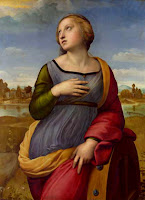
Raphael -
Saint Catherine of Alexandria


Herewith follows a list of symbols that I selected for you as symbols of Deruta:

The most important symbol of Deruta is the wheel. It is the symbol of Saint Catherine of Alexandria, who was tortured on a wheel. The wheel is the most important tool for creating everything that is round shaped in ceramics from the lump of clay.

Saint Catherine is the Saint protector of ceramicists and the Saint patron Day is November 25th. All workshops and shops in Deruta are closed on this day.

Saint Catherine of Alexandria was a very popular saint in the Renaissance period.

The plant of the rue in the Deruta
coat of arms (detail)
Another symbol of Deruta is the plant of the rue ("Ruta" in Italian) as per the coat of Arms of the City of Deruta. To me this is the true origin of the name "DE RUTA" rather than from "Destroyed". Who wants to visit a town that is destroyed?

Have you seen the most recent movie with Nicholas Cage called "Season of the Witch"? You may see what the plagues were like.

Raffaellesco by Cama, artist Elena Niccacci
A third symbol of Deruta is the dragon of the famous historical pattern known as "Raffaellesco", which takes inspiration from the grotesques painted by the artist Raffaello Sanzio (Raphael) in the Vatican rooms. On his turn he was inspired by the Domus Aurea (Golden home) of Emperor Nero. The pattern dates back to the second half of the 16th century.

For more about the grotesques go to this link in this blog.
Renaissance lovers' cup
from Deruta

The symbol of the city of Deruta in the advertisements is the vase called "gamelio"  (photo) which is a Renaissance lovers'cup and specifically in the luster technique. The lovers' cup was the gift of men to their beloved for special occasions such as engagement and wedding and was selected among several shapes. This vase can be found in ceramics plaques in the edicules of the town of Deruta and on the city flags.


***********************************************************************

Curiosity:
Nicholas Cage has purchased Cama products in the past, in particular the Raffaellesco goblets by Elena Niccacci either from Biordi's in San Francisco (Biordi Art Imports in San Francisco still has Cama pieces in stock) or from the Cottura stores in Los Angeles (wonderful stores no longer in business and Cama is proud to be among their suppliers). We would like to invite Nicholas Cage to one of our events in the United States in the future as guest star. Do you like Nicholas Cage?

--------------------


Original Posts by Roberta Niccacci -

FRIENDS OF CAMA 
Join the Facebook Page to Receive Blog Updates 


NEW!

Now on Twitter


lunedì 3 gennaio 2011

Deruta famous factories : "Società Maioliche Deruta".

The Castle of Deruta (downtown) in 1940.

Walking from the main entrance of the town of Deruta towards Castelleone, on the right side of the street we  may admire an aedicule for the prayer with a beautiful ceramics plaque of Deruta.

The buildings represent private homes and Churches in the upper part of town and the ceramics factories, which at that time were located downtown Deruta (1940), in the lower part of the plaque.

Detail of the plaque

The buildings that belong to the "Società Maioliche Deruta" factory are the five annexes in the lower row of the ceramics plaque, which are designated with the following descriptions (from left to right):
1. magazzino - reparto tornianti (warehouse - handthrowing area);
2. magazzino - reparto pittori (warehouse - painters area);
3. majoliche - direzione (factory head offices);
4. reparto pittori - reparto vernici - reparto terra (painting room - glazing room - greenware room), forno a   legna (kiln by wood);
5. reparto formisti (shaping room) - reparto stampatori (moulding room).
The logo of the "Società Maioliche Deruta"
factory, a vase dated 1358. 

The "Società Maioliche Deruta" factory is no longer in business but has contributed immensily to the growth of the art of Deruta.


***********************************************************************
The main gate to the town of Deruta is the Gate of  St. Michael the Archangel (Piazza district). The other gates are the Gate of the Borough  or Todi Gate (Borgo district) and the Perugia Gate  (Valle district) for a total of three gates.