|
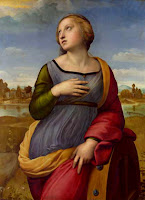
| Piero di Cosimo: Madonna Enthroned with Baby Jesus and Saints (circa 1493?). Saint Catherine is on the right with a piece of the barbed wheel, her symbol, and symbol of Deruta, at her knees. |
In the Hospital of the Innocents in Florence, Italy there is a beautiful painting on wood by Italian artist Piero di Cosimo (Florence, January 2nd, 1461- Florence April 12th, 1522), among Angels and Saints a very interesting portrait of Saint Catherine of Alexandria, kneeled at the right of the Virgin Mary with baby Jesus in her arms. St.Catherine is the Saint Protector of Deruta ceramicists and is celebrated every year in Deruta on November 25th. Saint Catherine became the Saint of Ceramicists of Deruta because she was placed on a barbed wheel to be martyrized (detail and symbol of the Saint are shown at St.Catherine's knees) and Deruta is famous for its hand-thrown pots on kick-wheels.
Indeed in Deruta, everything round-shaped, i.e. mugs, umbrella stands, bowls, cups, and curled vases are traditionally made on the wheel. This wheel is very meaningful to Derutese and is the symbol of their most beloved activity.
The story says that the barbed wheel of Saint Catherine of Alexandria (287 A.D.-305 A.D.), one of the tools of torture and death used at her time, fell apart thanks to the prompt assistance of guardian angels and the Saint was safe. Saint Catherine of Alexandria did not find her death by torture on the wheel. The piece of the wheel torn apart may be the witness of such a miracle. We may admire a series of frescoes about this story in the Church of Saint Francis in Deruta.
The Hospital of the Innocents in Florence (once also known as hospital of abandoned children, nowadays Institute of the Innocents) was the first specialized center for foundlings in Europe and it is a magnificent example of early Italian Renaissance architecture, started in 1419 upon the original project of famous architect Filippo Brunelleschi and formally opened in 1445.
The Hospital of the Innocents attested the usage of another famous wheel, the so-called "Ruota degli Esposti" (tr. wheel of the foundings, baby hatch), today cradle of life, a special rotating horizontal disk where mothers could leave their unwanted babies anonymously to be cared by the orphanage.
The wheel for abandoned babies was invented in France in 1188 and first adopted in Italy in 1198 at the "Ospedale Santo Spirito" (tr. hospital of the Holy Spirit) in Rome. Wheels have come back in usage in Italy and may be found in several public hospitals now. Modern baby hatches are comfortable warmed-up cradles behind a transom window hidden by a rolling shutter in an outer room that preserves the mother's privacy. The cradle has a sensor that activates by the closing of the shutter and nurses and doctors will arrive immediately to take care of the baby. The latest news in the paper is that a newborn started his new life last week at the Mangiagalli hospital in Milan where he was left with much care by his mother with a bottle of her milk and folded dresses. The baby was given the name of Mario and he may be adopted this year in October when he turns three months of life. His mother is allowed the same time frame for a second thought.
The story of the circles in my posts started with my discovery of Native American dreamcatchers, this is what I would like to complete this second post with, this will close my personal circle today.
by Finder
Long ago in the days of the ancestors, some of the children of the people were having strange, frightening dreams.
As the children talked to other children, the troubling dreams spread among them like a plague.
The parents of the children were concerned. The people wanted their children to be happy but they didn’t know what to do.
The people went to talk to the shaman. The shaman listened patiently as the parents told him about their distress.
The shaman told the parents that he could help. But he would need to spend some time in counsel with the spirits before he would have a solution.
The shaman would have to enter the dream world to find the answer.
Upon entering the dream world the shaman was approached by the four elements: Air, Earth, Water and Fire.
Air had already heard of the parent’s concern and had carried the message on the wind to the other elements.
All the spirits in the dream world loved the children and wanted to help return the children to their state of peaceful sleep.
The elements and the shaman dreamed together for a long time. They finally came to understand that:
Air could carry the children’s dreams.
Earth could hold the dreams within her hoop.
Water could wash and separate dreams - the wanted from the unwanted.
Fire could use the morning sun to burn up the unwanted dreams that are caught in the web.
Now all they needed was something to capture the dreams as they were carried by the air. Try as they might, the shaman and the elements could not think of a way to catch the dreams.
Grandmother Spider had been listening!
She said, "Beautiful, loving elements, I can help you as you help me every day." Grandmother Spider continued, "I can weave a special web that only wanted dreams can escape down to the dreamer."
And so she did, and the first Dreamcatcher was made.
The shaman brought the dreamcatcher with him when he made his journey back from the dream world.
All of the families of the people made dreamcatchers. The families hung them above where the children slept, in a place that was seen by the sun.
No longer were the children troubled by unwanted dreams. Instead, they had happy dreams and peaceful sleep.
And so, at last, Great Spirit looked into the dreams of the children and smiled.
 |
| The above story is part of the book by the same title and was published by Mother Bird Books. Finder, the author, writes Native American Children's stories. The book is available on Amazon.com |
-----------------------------
Curiosity: "degli Esposti" is a family name in Italy that is still in use.
"τι είναι όμορφο είναι επίσης καλό" is the original aphorism of the Greek philosopher Plato and means"What is beautiful is also good", see the first part of the post in this blog.