Blog's Translator

sabato 8 settembre 2012

IMAGO VITAE

Ikon with St. Joachim, Mary, and her mother Anne

JULY 26TH,  
St. Anne's Day


On July 26th in Italy, we celebrate the Feast Day of St.Anne, Mary's mother. St.Anne is usually juxtaposed to the message of fertility which is expressed in this ikon by her green dress. Anne means "favor" or "grace" and the name comes from Hebrew.

The cult of St.Anne existed in the Eastern civilizations since the 6th century and arrived in Western Europe in the 10th century.

Like the Virgin Mary, St.Anne is a religious translation of existing pagan myths and goddesses and we find St.Anne in many cultures. She is a translation of the concept of fertility and as a consequence of life, growth, and future.

In Deruta, one of the Churches is dedicated to St.Anne and is located in the borough of Deruta, the lower part of town, where the ceramics art tradition got started.

St.Anne was much venerated by the community of peasants and artisans in Deruta who celebrated this day with an important farmers market and attractions for visitors from out of town, in particular from Perugia. The tradition was brought back to life not too long ago, July 26th is once again an important Feast Day for the community of Deruta.

On top of the altar of the Church of S. Anne, a dedication written in Latin and dated 1744:
"STERILITAS FECUNDATA EXPIA  DEVOT [ION] E FELICIS •  ET CAROLI DETIRA TELLIS  ERECTUM A 1744". The translation to Italian is as follows: "Per sacro voto di Felice e Carlo Tiratelli si erige questo altare nell’anno del Signore 1744 a ricordo della sterilità resa feconda”, in English "Out of gratitude we build this altar in the year 1744 as a memory of the healed sterility by (the families of) Felice and Carlo Tiratelli".
It was probably a thank you for the birth of Luigi Tiratelli, Carlo's only child, last heir of the Tiratelli family in Deruta, who on his turn had no children like his uncle Felice. 
The brothers Felice and Carlo Tiratelli were the owners of the Church since the late 17th century, in earlier years this Church was a hospital for pilgrims on the way from St. Jacques of Compostela to Rome (about 2,400 kilometers with Assisi as an additional destination) according to the latest theories about this site. The original entrance plaque to the hospital is dated 1594 and is preserved in the ceramic art museum of Deruta. 


The ceramic plaque of the hospital of St. Jacques in Deruta
dated 1594 and still active in 1649 according to Giuseppe Fabretti (1787-1869),
a Derutese born in Casalina (a locality of Deruta) and in love with the history
of Deruta and Umbria. It is through Giuseppe Fabretti that we get to know
much about our past. (credit: Ceramic art Museum of Deruta).

The writing on the plaque is in Latin, language in use in Renaissance times as a rule: "Hospitalis Iacobi Sub Regim Comunis" (tr. The Hospital of S. Jacques under the control of the Commune").

Around the mid 17th century, the hospital of St. Jacques was transferred to downtown Deruta because it had gotten too small and this is when the hospital was turned into a Church and restored for this purpose.

The man in the plaque carries messages of life as well, on his left shoulder he has a shell, a symbol of the pilgrimage, the shell, in particular, meant that the person had been to St.Jacques of Compostela in Spain. This shell allowed the pilgrim to receive discounts on taxes due and special prices on tolls to be paid on the way back. The shell had to be sewn on the mantel. The tradition still exists and nowadays pilgrims sew their shells on modern backpacks. Also in the origin, the shell was a practical tool to drink surface water from ponds on the round trip to and from the Sanctuary of St. Jacques of Compostela. Because this person has no halo around his head, we may suppose he was the example of a pilgrim (the cane, the bundle, and the Gospel in his right hand are additional symbols). 

Finally, in Renaissance art, the shell was the pagan symbol of fertility as per paintings such as the "Birth of Venus" by Botticelli, in this painting Botticelli painted the shell by inscribing it in the golden number.

Sandro Botticelli, "Birth of Venus" (circa 1482-1485), the shell is a symbol of fertility, Venus
is the image of life, Imago Vitae in Latin.


lunedì 3 settembre 2012

RIDING THE HORSE - DIRECTION: DERUTA

The votive offering was painted by Perugino for the community
of Deruta (1477-1478). The plague was over in the town.
Saints Rocco and Romano were considered anti-pestiferous.
(Deruta Painting Gallery, originally in the Church of Saint
Francis in Deruta) 
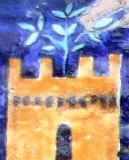
The castle of Deruta in a ceramic plaque of the 1940s  (photo by Roberta Niccacci)

If you are in the  Piegaro - Città della Pieve - Fontignano area you might think of yourself as belonging to the flourishing Renaissance history of Deruta; by accompanying Maestro Pietro Vannucci known as "Perugino" (1448-1523) from Città della Pieve to Deruta in one of his trips to the town of ceramics.
This great artist of Italian art history was born in Città della Pieve and died in Fontignano, where he is buried. Perugino was one of the most important local and famous artists who inspired the ceramic art of Deruta, together with Bernardino di Betto known as "Pinturicchio" (1452-1513).
Between 1477-1478 the community of Deruta commissioned Perugino a votive offering (that we call "ex-voto" using the Latin expression) as a thank you for the end of the town's plague. This is one of the reasons why Perugino came to Deruta often, painting his fresco for the town of Deruta.

Also during the Renaissance period, Deruta was a famous place for VIPs such as the Borgia and Sforza families, artists, merchants, and bankers.

Detail of a fresco by Perugino from the "Nobile Collegio
del Cambio" in Perugia (money exchange office)
Deruta ceramic artists took their inspiration
from this hat's floral swirls as an example. 

At that time according to available literature, there were about ten ceramic workshops, churches, a hospital for pilgrims, and a few banks with a population of about one thousand Derutese.

Reproduction of a ceramic pitcher
from the origins of the history
of ceramic in Deruta. 
In the same years Perugino worked in Deruta (1477-1478), elegant ladies used to come to Deruta and visit the castle which was a property of the Municipality of Perugia. Indeed in the late 15th century and in the 16th century, Deruta became famous for creating decorative floor tiles for Churches and Chapels. Examples are the "Cappella Bella" (beautiful chapel) in Spello, namely for the Baglioni Family, nobles of Perugia, and the benedictine Church of Saint Peter in Perugia.

Detail of a Deruta handpainted wall plate from a fresco by
Pinturicchio. The writing is in Latin: "Ab Amicis Iusta
et Honesta Petamus" (tr. Don't ask your friends too much)
by famous Latin writer Cicero.
Deruta ceramic history probably started in the late 13th century. The first document witnessing a delivery of pitchers to a convent in Assisi goes back to 1282, which is a very recent discovery. The tradition definitely started in Deruta thanks to the availability of clay on the banks of the river Tiber, which runs in the town outskirts as well as the availability of woods on the hills over Deruta, necessary for furnaces. The art of ceramics itself probably came from the influence of Etruscan and  Roman cultures. Rome in particular was specialized in accessories for the table and its ceramicists worked at that time along the river Tiber's banks.

Handpainted Reproduction of the famous work of
art by Leonardo da Vinci "Lady with an Ermine"
(By Romano Ranieri)
In the origins, colors in use were only a few: green and manganese on white glaze. In town, there are a few studios that still do faithful reproductions of this style considered as sort of rustic compared to the Renaissance style productions.

Indeed with the passing of time, the ceramic tradition evolved to more elaborate designs which are distinguishing Deruta. Namely creating historical drawings such as the"Raffaellesco" and "Ricco Deruta" patterns; with a wide palette of colors from blue to yellow, orange, rust, green and red. Inspired by Renaissance talented artists they started reproducing scenes, profiles, and decorations into ceramic pieces, imitating the noble art of frescoes.
A second Renaissance period of Deruta ceramics dates back to the 1920s, thanks to the passionate research of the savants of the town of Deruta. The tradition came back to life towards the end of the 19th century after a long period of absence as a consequence of the Industrial Revolutions.
The original painting by Leonardo da Vinci,
"Lady with an Ermine" (about A.D. 1490) 
Latin was the language in use in both Renaissance periods and also in use nowadays for important writings on decorative plates, show plates, and decorative home accessories.

Saint Catherine of Alexandria is the Patron Saint of Deruta ceramicists and is celebrated every year on November 25th. Her symbol is the wheel, known as Catherine's wheel:  Deruta is famous for round shapes and terracotta's most production is made on the kick wheel. This is what Deruta is famous for and why this Saint is so meaningful to ceramic artists.

Rue on top of the
tower.  this is where
the name Deruta
comes from.
Detail of the crest 
of Deruta 
Deruta ceramics go under the name of "majolica" or simply "maiolica". "J" in Italian is an old-fashioned way of writing "i", no longer in use... More information and curiosities are in this blog. Follow www.friendsofcama.blogspot.it, like my Facebook page to receive blog updates!


p.s. Piegaro is about 40 km away from Deruta by car, an estimate 50 minutes drive.


-----------------------------------------

- Original Posts by Roberta Niccacci -

FRIENDS OF CAMA 
Join the Facebook Page to Receive Blog Updates 

NEW!

Now on Twitter

martedì 28 agosto 2012

PARADISE LOST

John Milton (1608-1674) at the age of 21. He
wrote "Paradise Lost" at the age of 59.  

Hieronymus Bosch (The Netherlands 1453-1516),
Owl, detail from "The Garden of  Delights"
(1480-1490) 
The first thought when I read the title 'Paradise Lost' goes to John Milton, English author of "Paradise Lost", epic poem dated 1667. Indeed Albert Einstein in his book "The World As I See It" dedicates a short chapter to what he calls "paradise lost": the time before which Latin was the language of scholars, artists, inventors, and intellectuals from all over the world.

Until that time in Europe innovators were united by common ideals and politics could not interfere much with their mutual beliefs. Albert Einstein stresses out that Latin as a common language reinforced the power of savants in society. This attitude lasted in Europe until the 17th century - the title of the chapter by Einstein "Paradise Lost" may not be a coincidence belonging to the poem by John Milton to the 17th century. John Milton' book sealed the end of important periods such as the Italian Renaissance,
Allegory of the Owl from
the Famous Contrade of Siena

What makes it a paradise lost according to Albert Einstein is the fact that since that time politicians have taken the place of savants in the society and have become representatives of international ideas that were once under the intellectuals' surveillance.

This is a concept that Albert Einstein wrote about in the first half of the 20th century. Nowadays Latin is a dead and abandoned language in Italy. Latin is interesting to understand the origin of words i.e. in etymology; for limited usage of scholars in specific fields such as epigraphy. In order to be a lawyer or a doctor, it is not necessary to study Latin in school anymore.

Herewith follows the original text by Prof. Albert Einstein from "The World As I See It":

Paradise Lost
Semper Solus (tr."forever alone)

"As late as the seventeenth century the savants and artists of all Europe were so closely united by the bond of a common idea that co-operation between them was scarcely affected by political events. This unity was further strengthened by the general use of the Latin language. Today we look back at this state of affairs as a lost paradise. The passions of nationalism have destroyed this community of the intellect, and the Latin language, which once united the whole world, is dead. The men of learning have become the chief mouthpieces of national tradition and lost their sense of an intellectual commonwealth. Nowadays we are faced with the curious fact that the politicians, the practical men of affairs, have become the exponents of international ideas. It is they who have created the League of Nations."

In the same book, Albert Einstein writes about the Italian Renaissance. The chapter is entitled "Society and Personality"). Herewith follows an abstract:

Official Emblem of the Contrade of the Owl
Siena, Italy  
 [...] "Only the individual can think, and thereby create new values for society--nay, even set up new moral standards to which the life of the community conforms.
Without creative, independently thinking and judging personalities the upward development of society is as unthinkable as the development of the individual personality without the nourishing soil of the community.
The health of society thus depends quite as much on the independence of the individuals composing it as on their close political cohesion. It has been very justly said that Græco-Europeo-American culture as a whole, and in particular their brilliant flowering in the Italian Renaissance, which put an end to the stagnation of mediæval Europe, is based on the liberation and comparative isolation of the individual." [...]

From the critical essays and the literature available about these distinguished personalities, Albert Einstein and John Milton, it is possible to notice that John Milton and Albert Einstein both wrote out of their passion. They were among the greatest thinkers and promoters of independent thinking.

However, I am wondering if the reference to the "paradise lost" is just a coincidence of Prof. Albert Einstein as a man of humanities or as a freemason. Indeed Prof. Albert Einstein is listed as a freemason among many scientists and important people in the world.

Despite John Milton was not a freemason himself because of the time limit - the modern organization started as an initiatory order in the early 1700s -  there are many descriptions in the poem by John Milton that the Freemasons have used as their manifesto. I wish I knew more about what freemasonry really means or has meant for the United States. This is so fascinating!  There are several masonic symbols in the US dollar bills as an example, including an owl which is almost invisible to the naked eye. The owl is also a symbol of secret societies.

I am now thinking of the owl, specifically the "owl of Minerva" (a goddess also known as Athena) and the date in the bill at the foot of the pyramid. This piece of information takes us back to the so-called "Order of the Enlightened" which was founded in Germany in 1776 as a response to the Freemasons and on the same year of the United States of America's declaration of independence.

Albrecht Dürer (Germany, 1471-1528), Owl, 1508
The owl of Minerva is the symbol of rational knowledge (influence: moon, reflected light) versus intuitive knowledge (influence: sun, direct light) whose symbol is the eagle. The owl can see where others can only see shades and darkness. This bird is also the symbol of wisdom and the symbol of philosophy.

The owl of Minerva is a symbol
of the "Order of the Enlightened"

****************************************************************************

-----------------------------------------

- Original Posts by Roberta Niccacci -

FRIENDS OF CAMA 
Join the Facebook Page to Receive Blog Updates 

NEW!

Now on Twitter

giovedì 23 agosto 2012

FERIAE AUGUSTI

A coin from the time of Emperor Augustus (63 B.C.-14 A.D.)
"Caesar Augustus -Divi F(ilius) - Pater Patriae"
(tr. `Caesar Augustus,  Son of God, Father of  His Country') 

August has been for many decades the official month in which to take the annual Italian holiday. Everybody took their holidays in August. One reason is that August is the hottest month of the year in our peninsula. Therefore the perfect occasion for a two to four weeks vacation for many Italian families.

I have always wondered why there were so many Italians born in May? As there are nine months from August to May...there is the answer. August is definitely a hot month of the year in Italy!

This year in particular we are having torrid heat waves called "Lucifero" (tr. Lucifer), "Acheronte" (tr. Acheron), "Minosse" (tr. Minos), and "Caligola" (tr. Caligula) with reference to Hell in the epics as well as to classical Greek mythology. Luckily "Beatrice" (Beatrix was the beloved of Dante, the author of the Divine Comedy and who described Hell in a very original way) will come and deliver us from the heat with her summer storms on Sunday!

While the month of July is dedicated to Julius Caesar, the month of August is dedicated to Emperor Augustus. in order to have the same month length, in 8 B.C. the Senate of Rome decided to add one day to the month of August by deleting one day from the month of February.

The fact of being August the traditional month for vacations in Italy, for rest ("Feriae" in Latin, "Ferie" in Italian) is maybe the reason why they say that no one is in Rome in August. everyone goes to the country in August enjoying events such as the Renaissance corteges and Festivals in small towns and villages. There are so many events everywhere in Italy in August!

August 15th is the most important feast day in August and probably the second most important Feast Day of the whole year in Italy besides Christmas for the Catholic Church. This day for the profane is known as "Ferragosto", originating from the Latin "Feriae Augusti" (tr." Augustus' Day Off/Rest").  For the official religion, it is the day of the Assumption of the Virgin Mary to Paradise. This is why August 15th is a holiday in Italy. All stores, offices, and factories are closed.

Bettona, Italy is a small village near
Torgiano, they are specialized in cooking
roasted geese and they organize
a dedicated festival every year.
 
On August 15th in my region, Umbria (sister region of Tuscany, Marche, and Lazio just like the four corner states in the United States), we enjoy the tradition of eating "Oca Arrosto" (tr. roasted goose) with family and friends for lunch, usually accompanied by potatoes. Here in Piegaro, Italy they serve the "Oco Arrosto", the male goose. This idea made me laugh so hard when I first heard it! They call it "Oco" (tr. male-goose).

In reminding ourselves of Rome's history, it is strange to think that August is the name of a Roman Emperor and at the same time the month in which the Umbrian people eat geese. Indeed geese were the sacred animals of the Goddess Juno (or Hera) and geese are the heroes of a famous legend that is part of Roman history. The story takes place about 390 B.C. and is about the failed attack of the Gauls on the city of Rome: On the Campidoglio (tr. Capitol of Rome) at the Temple of Juno, many sacred geese were used to wander freely. Highly respected by the Romans, geese were faithful watchers, considered better than watchdogs. So one night the Gauls attacked the Temple of Juno while the Roman soldiers were asleep. Because geese were awake in order to watch the Temple day and night, they awoke the Roman soldiers with their cackling. In response, the Roman soldiers delivered the Temple from the Barbarians with great energy. Therefore it is said that Rome was once saved by the cackling of its geese.

Despite the above story is known as a legend, we know that later on a new temple was built on the Capitol of Rome, called Iuno Monetae (tr. "Admonitory Juno"). Secondly, a new building was added producing coins, which was called "Officina Moneta" (tr. "coins workshop"). The name was inspired by the closeness of the Temple of Juno Monetae. As a consequence, the name "Moneta" was extended to the coins themselves. In Italian, we still currently call coins with the name of "Moneta" (singular noun) and "Monete" (plural noun). How beautiful to know the origins of the words and the things that we use!


Prof. Albert Einstein
(Ulm, Germany 1879- Princeton, USA  1955)
Professor Albert Einstein mentioned the legend of the faithful geese in one of his attendances in the United States. It became one of his famous quotes published in his book by the title: "The World As I See It", which is following herewith:
"Reply to the Women of America -
An American Women's League felt called upon to protest against Einstein's visit to their country. They received the following answer.
Never yet have I experienced from the fair sex such energetic rejection of all advances; or, if I have, never from so many at once. But are they not quite right, these watchful citizens?
Why should one open one's doors to a person who devours hard-boiled capitalists with as much appetite and gusto as the Cretan Minotaur in days gone by devoured luscious Greek maidens, and on top of that is low-down enough to reject every sort of war, except the unavoidable war with one's own wife? Therefore give heed to your clever and patriotic women-folk and remember that the Capitol of mighty Rome was once saved by the cackling of its faithful geese."


-----------------------------------------

- Original Posts by Roberta Niccacci -

FRIENDS OF CAMA 
Join the Facebook Page to Receive Blog Updates 

NEW!

Now on Twitter

venerdì 17 agosto 2012

TICKETS, TOKENS, TRICKS

The price list of a brothel in Italy is dated June 1932. Brothels were abolished in Italy in 1958 by  the law of  Senator Lina Merlin following the abolishments of State prostitution in France in 1946
and later in the Countries of the United Nations.


This image is from the book "Prezzario" (tr.Price List) published by Kurumuny Editors, 2010
ISBN 978-88-95161-51-8

English translation:
Price List of a famous house of pleasure
---------------
Discounts for young soldiers only
---------------
Regular appointment: 1,30 Lira
Double appointment:
2,50 Lira
15 minutes:
3,05 Lira
half an Hour:
4,50 Lira
One  hour: 7 Lira
Two hours: 10 lira
-------------
The home offers
free soaps and towels!


In Italy, social healthcare is free for most of it, such as for general hospitals following emergencies and for surgeries. Exceptions are specific consultations, blood tests and examinations that your doctor will prescribe to you for specific check-ups. In these cases, the Italian government charges part of the costs based on the patients' income and this contribution is called the English word "ticket". We call these fee contributions "tickets".

Another example of a ticket price list
dated 1939
English Translation:
Amounts due to the esteemed house:
(left) Fast service: 1.10 - 20 minutes: 3,60 -
full hour 7,50 ---
(right) double 2,00 - half an hour 4,80 -
two hours 12,00 - prices are in Lira
----------------------------
For the toilet no need to go outside
any more
----------------------------
water, soaps and towels are an additional 20 cents.
I have recently learned that the word "ticket" translated at one time the Italian word "marchetta" which was the single fee clients were charged in brothels for a prostitute's session. In Italy brothels were called "casa chiusa" (literal translation "walled-in homes") or "casa di tolleranza" (tr.legal prostitution houses). On a the higher language register they were called "postribolo":  which comes from the union of the Latin verbs "prostare" (to be for sale in public) and "stare" (to be still, to be motionless, waiting) which gives birth to the noun "stibulum";  as a consequence "pro-stribulum", "pro-stitum". This is also where the word "prostituta" (Engl."prostitute") comes from. In Italy, these places were commonly known as "casino" - not to be confused with the Italian word "casinò" (the accent is on the last letter of the word and describes i.e. the casinos of Las Vegas and Montecarlo).

Brothels were legal in Italy and under the supervision of the Italian government from February 1860 (based on a decree by Camillo Benso Count of Cavour on the year before)  to September1958 after about a decade of fights against legal prostitution by Senator Lina Merlin, the first woman to seat in the government of the Italian Republic.

In order to receive your medical assistance in the Italian healthcare system, tickets must be paid in advance. The same thing happened in most of the brothels in Italy, especially in the major cities such as Rome, Milan, Genoa or Naples - payment was in advance - while in smaller towns you could decide about the sessions you were interested in with the prostitutes in their rooms. Prostitutes would give their clients their 'tickets' or 'tokens' accordingly, which had to be paid upon exit to the "Maîtresse", a French word for the brothel's manager.

Reproductions of brothel tickets, they look like fiches, coins, tokens.
These tickets were created as entrance tickets for a Music Hall
that was opened in Milan in the 1990s and was originally
a famous brothel. It was called "La Marchetta di Fiori Chiari". 
'Tokens' were copper disks with a hole in the center in order to be inserted in e needle as proof of payment. They were usually placed on the table of the "cocotte", a French name in use in the brothels in Italy for prostitutes.

Philippe IV Le Bel 
The word "brothel", in Italian "bordello", comes from the French expression "au bord de l'eau" (tr. "at the waterfront") based on the decree of French King Philippe IV Le Bel (1268-1314), who ordered that ladies could practice the art of prostituting in boats near the borders of rivers and lakes.
Fresco from a famous wolves' den
in Pompeii. Frescoes were probably
a way to advertise
the specialities on offer.

Brothels in Ancient Rome were called "Lupanari" (tr. "she-wolves' den/lair"), for the people in Ancient Rome "she-wolves" was a common name for prostitutes.  'She-wolf' is nowadays a very seducing woman's name in expressions such as: "che lupa!" (tr. "what a she-wolf", "what a sex-bomb").
Edouard Manet, Olympia, 1863: this work of art elicited a
scandal at that time, the subject was contemporary and
the model was a prostitute in her bedroom. The black cat
was a parody of the faithful dog at the feet of Venus. 

The French word's usage for brothels' actants is not by accident. Brothels under the supervision of the government were invented in France towards the end of the 18th century. Accordingly, they were first abolished in France in 1946 following an abolitionist movement that spread through Great Britain, Germany, the United States, Canada and other countries.

In the Renaissance period in Italy prostitution took its highest peak. In Rome, there were supposed to be about seven thousand harlots. At that time prostitutes were normally called "puttana" (tr. whores"). In the Renaissance period it is interesting to know that a high percentage of the prostitutes were "cortigiana" (tr."courtesans"): educated to art, literature, music, politics sometimes painters and musicians themselves.

Courtesans were endowed with beauty and talents, models for artists and scholars,  lovers of important artists and cardinals; they paid their taxes like in ancient Rome and made fortunes out of their art. This lasted until the Counter-reformation (also known as Catholic reformation) in the second half of the 16th century put restrictions to prostitutes because of their becoming too rich.

Titian, Venus of Urbino, 1538: it was originally a
painting for a wedding chest for educational purposes. 
The word "prostitution" was first used in the late 18th century and has always had a very negative, sinister meaning. On the contrary in the origins, it was a sacred art that was practised in Ancient Greece in the temples of Venus and Aphrodite. It was also practised in Southern Italy and in important civilizations such as Babylon, Ancient Mesopotamia and Ancient Persia.

Renaissance traditions and mores take inspiration from the classical ages, this is also the case of the Renaissance courtesans who originated in Ancient Greece, where they were called "Etera".


Raphael, Madonna Sixstina, 1513-1514: According to some
sources the model was a courtesan, Beatrice Ferrarese,
known as "La Fornarina" (tr. the baker) a euphemistic nickname
that was in use among the courtesans of high rank at that time.
The mystery about "La Fornarina" still exists. By the way,
I didn't know that the most famous angels of all time
were part of this painting!


There is nothing I wish to add to this post, except for one sad thought, thinking of all the women (and men) who nowadays cannot find a place to practice what they wish to do, out of choice or by constraint we will never get to know.

I would just stay for a moment on the concept that to me everything deprived of art, love and passion sends messages of death.  In this case, the word "prostitution" itself expresses the involution of sacred sessions involving the art of seduction, which by choice can be performed for one man for a lifetime (Titian's painting) or for more men for a shorter time each (Manet's painting). It depends on the different personalities and with role-playing that is very intimate and cannot be subject to the judgement of the Church, of institutions or other groups of people with the aim of destroying something that has an important historical background.

Sacred or profane, what matters is the way
we do things,. We may be virtuous in the most
delicate life's fields! 

-----------------------------------------

- Original Posts by Roberta Niccacci -

FRIENDS OF CAMA 
Join the Facebook Page to Receive Blog Updates 

NEW!

Now on Twitter

sabato 11 agosto 2012

TRANSLATIONS

I found this beautiful shot on a friend's wall on Fb and I was captured by its beauty, butterflies are all different.
Each butterfly is one world.  There are not two butterflies that are alike, just like languages.

Translating is an art and has its rules. Professionally a person who speaks Italian as her native language like myself can translate from any foreign language to Italian and not the reverse. Translating from Italian to English is considered as an exercise, a study, therefore when someone Italian translates something into English, editing is strictly required.
Each translation is different from person to person, there are as many translations as our personalities. Some people prefer the verbal usage of the sentence. Some other people prefer the nominal version as well as free translations. Editing is different from person to person likewise.

Communicating is a beautiful gift
The verb 'translate' and the word 'translation', come from the Latin verb "Traducere" and originally "Trans Ducere" which has several meanings such as: " to take someone from one place to another", "to transfer a writing from one language to another", "explaining, interpreting something".

Indeed the Italian verb/noun "Tradurre" is still in use in our language when you transfer prisoners from one place to another. The verb "transfer" is also helpful in this case. It comes from Latin as well and it originates from the verb "Trans Ferre": to take from one place to another. It is also used as a language metaphor to transfer the meaning of a word or an image to something similar but with much more power of expression.

I would appreciate very much having my blog posts edited by an English proofreader. It is an opportunity for me to learn a lot about new trends and usages of the English language. In my case, it is about American English. I also like sharing my thoughts and discoveries with my proofreaders. In other words: the art of translating.
knowing a foreign language opens windows
on the world

In middle and high schools in Italy, books are based on British English which is spoken in Great Britain and Ireland only. However American English is the most popular language nowadays. Just like Ancient Greek, that was the 'must' foreign language to learn in the classical ages.

Indeed nowadays the language that you end up speaking when you practice English as a second language is American English. It is a  fun language because there are new words, neologisms, new expressions every day.

American English is to some extent British English younger sister. As a consequence, it is more flexible. I actually think of British English as an old auntie to American English. I have spoken British English very rarely.

BRITISH ENGLISH-AMERICAN ENGLISH COMPARISON. AN EXAMPLE: I actually have a story to tell about the first difference I noticed between British English and American English. I was 16 years old and learning English with much passion.  I started writing down every single word and expression I learned from foreigners I met in Perugia, Deruta, and everywhere I could "Attaccare Bottone" (tr." to engage somebody in conversation).

I eventually made friends with a lovely lady from London and her nieces who were my age. This lady lived in Deruta at that time. She was a writer. When I visited London a few years later I received an invitation to dinner from my friends' family and other guests were invited. Towards the end of the dinner, I expressed myself by saying out loud "I am stuffed". As soon as I said that, someone at the table corrected me very politely by saying the correct English expression:  "I have had an elegant sufficiency". I will never forget that dinner. Everybody laughed and had fun with me learning English! Who knows who still uses this expression in English. maybe it is obsolete by this time. so many years have gone by.
In Italian, we have the expression "Attaccare Bottone"
which literally means "sewing/stitching a button"
but used as a phrasal verb with the meaning
"to engage someone in a conversation"

NOTE ABOUT ITALIAN LANGUAGE: compared to both languages, American English and British English, Italian is not as flexible. It is rather complicated and sometimes not logical at all. Logic does not seem to be a priority. I link this to the fact that not being logical and practical takes us straight to bureaucracy.

Regarding this thought, my question is: is the language responsible for our actions and as a consequence influencing the course of our life and of our communities? I personally believe that languages have a huge influence on developing our thoughts. I am getting more and more curious about this subject. I want to understand why everything in Italy is so complicated, I must find the origin of it and I wish I could find a solution to this problem and see it solved within my lifetime frame.
In the world, there are probably as many languages
as the number of our flags. 


As you may understand the above wish is a dream.  Therefore I better go back to what is more realistic and pertaining to my small world: the art of translating.

I love when someone proofreads my writings. This is my best way of learning a language, of going a step forward and improving my knowledge of foreign languages.

Languages are the fruit of dialogues, exchange of ideas, it is the purest way of communicating. It is important to me to catch the opportunity of learning by editing my mistakes.

Additionally, by repeating the exercise of editing mistakes in a foreign language, I wish to emulate the same process in my private life. By doing this I can learn more, improve and become a better person. However, there are mistakes that I repeat frequently and I cannot get rid of!

About the important subject of mistakes in our life, I am herewith repeating a statement I read on a friend's wall on Fb: "Eventually, people will realize that mistakes are meant for learning and not for repeating" which is probably the American version of the Italian motto: "Sbagliare è Umano, Perseverare è Diabolico" (tr." making mistakes is a human weakness, repeating mistakes is evil").

I wish everybody a good editing job in their lives. We can have a better world by editing ourselves first. Only example matters.  It is really efficient for the step forward to positive thinking and perfect making Renaissance style.


-----------------------------------------

- Original Posts by Roberta Niccacci -

FRIENDS OF CAMA 
Join the Facebook Page to Receive Blog Updates 

NEW!

Now on Twitter


sabato 4 agosto 2012

WALLED-IN DOORS

Walled-in doors are everywhere in Italy 

Dear Readers and Friends of Cama, I apologize with those of you who are not Catholic, in this blog you will find many references to the Catholic Church (and the Orthodox Church for their ikons) there is no intention of advertising the official religion of Italy. In the past the Roman Catholic Church was a major patron of the arts and therefore most of the works of art in Italy are located in churches or are religious places themselves. The greatest Italian Renaissance artists have worked for Popes. I look at churches as museums  and inspirational places for their works of art along with appreciating the gift of peace and their purifying scent of incense. 

WALLED-IN DOORS IN ITALY

The most famous walled-in door in Italy is called "Holy Door" and is located in the Basilica of Saint Peter in Rome. This door is dismantled by the usage of a pickaxe every beginning of the Jubilee Jear of the Roman Catholic Church, on the Christmas eve of the previous year. The Holy Door remains open for the Jubelee celebrations and covered up again on February 6th of the following year. The Jubilee takes place every twenty-five years and is the year of forgiveness, reconciliation, peace, salvation and payment of debts to debtees and creditors. There are also Jubilees for special occasions. Pope Boniface VIII started the Jubilees tradition based on an old Jewish tradition in the year 1300, the last Jubilee was in the year 2000 and the next one will take place in 2025. The city of Rome is already  getting ready for this important event.

Rear of the Walled Holy Door in the Basilica of Saint Peter in
Rome. (photo by Paul Bruder)

Rome was one of the applicant cities
for the XXXII Olympic games of 2020. The name
of the hosting city will be announced on September
7, 2013 among the remaning cities which are as follows:
Baku, Doha, Istanbul, Madrid and Tokyo.  
The Jubilee is a great opportunity for pilgrimages, after the withdrawal of Rome as the city of the Olympic games of 2020, Rome looks forward to the Jubilee of 2025 as the next opportunity of revival of the city with an international echoing for the whole Italian peninsula. 
Symbol of the pilgrims
(it was originally used to drink clear
waters in ponds along the way to
the sanctuary of destination)

The Jubilee of 1950 must have been a very important Jubilee. It started the tradition of mass religious pilgrimages. In Rome there were three millions and a half visitors that year. Fifty years later, in the Jubilee of the year 2000 pilgrims visiting Rome were twenty-five millions (more than seven times that number) with seventy thousand volunteers. 


Example of a walled-in door 
Under different circumstances in 1971, I assisted to the covering up of a door and it was not as promising. That door was never reopened. This event changed my life and the life of my family forever. 


Popular Italian saying:  "Chiusa una porta, si apre un portone" (tr. "when one door closes, one gate opens"). 


(to be continued...) 

-------------


Original Posts by Roberta Niccacci -

FRIENDS OF CAMA 
Join the Facebook Page to Receive Blog Updates 


NEW!

Now on Twitter