Blog's Translator

domenica 27 marzo 2011

Hope is not a plan


In the town of Deruta in times past there was a congregation called "Speram bene!" which makes me think of the saying that my American customer and friend Katherine said to me "hope is not a plan". Where there is no planning there is hope and the expression we use in Italy in this case is "We hope for the best", "Speram bene" (in the Umbrian dialect)!

At Cama we are planning to move from the current location and find a new and innovative site for our visitors. We understand that customers want the "experience" although I visit them frequently and offer them better prices compared to the prices at the workshop. 

It is not the first time that Cama moves from its original location. In the beginning the Cama workshop was located towards the entrance of town, at the south exit on the left side of the street driving from Rome. Then Cama migrated to Via Tiberina, 113 (the current location) in the 1960s when the area was not residential.
When my granfather became independent from his last partner in the beginning of the 1970s, Cama has been splitting the building with this ex-partner.

My project is to go a step forward and have my own space, possibly in the open countryside or inside the town of Deruta with more to offer to our visitors. I have ideas in mind on how to make the experience really interesting!

The Cama original logo
in the Cama booth
at a recent trade show in Europe. 
In the meantime I have worked on rescuing the original Cama brand name. With our graphic designer we found out that the original lettering is based on the Renaissance concept of the "Golden Section" or "Golden Number", which gives us much hope about a new future for Cama!

We look forward to moving forward. New location coming soon. 

Thank you very much for your patience.

The only and authentic Cama! Cama and its Classic Deruta patterns
are a registered trademark of Borgo Deruta, Srl. 

venerdì 25 marzo 2011

March 25th: Feast of the Annunciation

The Annunciation that I found for customers in the United States
as a replacement for their plaque which was shattered. 
Meeting customers' needs is a way of knowing more about our common culture and traditions.

Recently through our service of ceramics huntings I served customers from the States looking for a ceramics plaque that they could not find as a replacement.

Thanks to the fact that I was born in Deruta and spent my whole life in ceramics I forwarded the exact same piece they were looking for. For me this is real fun!

In exchange I learned about the Feast of the Annunciation that for some reason I had forgotten about. The Feast of the Annunciation is celebrated on March 25th on the equinox of Spring and is considered as the "origin of all Feasts".

According to the oriental church this feast belongs to the twelve great Feasts as depicted on the iconostasis.

***********************************************************************

Remember about our service of Ceramics hunting. We will be happy to be of help. We have made several customers happy already in our short history. Enjoy this experience with us! Write to: info@borgoderuta.com.

lunedì 14 marzo 2011

God save the Princess: dream marriage at the Court of England

Catherine de' Medici, one of the greatest spouses
in the Italian Renaissance. 


In Italy until a couple of decades ago, maybe three decades ago, our mothers in Italy used to prepare a wonderful dowry for us, with mostly handmade linen sheets for a king-size bed, including a wedding comforter and a nightgown as a basic trousseau.

Because I never got married, to tell you the truth I have been using my nightgown for many years now. It is so beautiful and I feel like a princess each time I wear it. It is so much like the 1970s because it is exactly when I received it as a gift. It is embroidered by hand and lavender is its color.

Quality products last forever!

On the contrary, one of the greatest spouses from Italy was Catherine de' Medici who married the French King Henry II. The marriage was celebrated on October 28, 1533.

In our projects for BorgoderutA a complete collection dedicated to women and taking inspiration from famous dowries. Dreaming is a privilege to which everybody is entitled. Che bello sognare! (tr. dreaming is beautiful).

**************************************************************************
This is what the Marriage of William and Kate made me think of. By the way, Kate Middleton in one of her recent official visits was wearing a suit by Luisa Spagnoli, one of the oldest factories in Europe and located in Perugia, Italy.

-----------------------------------------

- Original Posts by Roberta Niccacci -

FRIENDS OF CAMA 
Join the Facebook Page to Receive Blog Updates 

NEW!

Now on Twitter


venerdì 4 marzo 2011

Why Cama has followers: the gift of talent

"I have been for years the face of Cama and enjoyed
selling her ceramics. I cannot live without this joy of life."
Roberta Niccacci
"Avere stoffa" is an idiomatic expression in Italian which originates from the word "stoffa" = fabrics (the same ones you see in the background of the blog. Aren't fabrics lined in old stores one of the most fascinating things in the world? I can smell the scent of them in the historical  stores downtown Perugia).

The saying "Avere stoffa" means "to have what it takes", "to have outstanding gifts for something", "to have the genius for" and also "to have the makings of something".

Now that Cama was forced to interrupt the production and resume her art hopefully in the near future, I am confirming that there is a huge difference with other products in the market: ceramics are the same from far, the flavor might be the same but in the Cama products there is a fine line which connects all the patterns and shapes.

Why is it possible to spot the Cama style among thousands of pieces? This is not a new topic for Deruta. Other factories and workshops have made a statement in the past century, such as La Salamandra, Serafino Volpi  and the Grazia factory, which is still operating. These are some of the examples.

You may notice the gap when the Cama product is being reproduced by different hands: it loses all its fascination, its power, its elegance and strong personality. Cama has created her own style. It takes a lot of talent. I love Cama!

martedì 1 marzo 2011

New Exclusive Service for our Readers: Ceramics Hunting

Special note for our Readers


Cama is now part of a larger project called Borgoderuta,  which includes customized services to the customers. The project is a work in progress and we are building it with you. 

If you are visiting our blog by chance, because you were looking for a ceramics replacement from Deruta or additional pieces, that you cannot find by yourself, please feel free to contact our "daisy service". We will be happy to help you in your research.


Exclusive services for our patrons
at Borgoderuta. 
Daisy service includes:

Confirmation of the product with you by email or telephone through digital photos;
Maintaining the price established by the supplier;
Shipment to your address door to door insured ar cost;
A flat service fee.

A satisfied customer writes "The dishes arrived yesterday, and they are perfect!!! This was a great business service, and I'll spread the word around! - Barbara P."


Let's color the dasies together! 

Contact details: info@borgoderuta.com
Roberta Niccacci
Deruta, Italy


"daisy service" is an original creation of Borgo Deruta, srl, all rights reserved. 

lunedì 14 febbraio 2011

The Cama history: Saint Valentine of 2011

The Chameleon, in Italian "Cama-leonte":
times of change for Cama, finding new
and safe waters in the stream of events.

At Cama, we celebrate Saint Valentine with the promise of coming back in production for the year 2012!

This interruption is important to us in order to adjust to our new business model.
I personally love Cama and Cama products.
I will do all the efforts necessary to bring the art back to all the Cama loyal customers.

A special thank you to the Friends of Cama for their support.

Happy Saint Valentine to all the people in love with art!

Roberta Niccacci

**************************************************************************

In the Renaissance, the chameleon was the symbol of air. The Universe for the Renaissance scholars was the summary of the four elements: fire, earth, air, and water. Each element had a specific symbol.

In the past century, a successful company established in Perugia and producing Deruta ceramics took inspiration exactly from these Renaissance symbols. They selected the "Salamandra" (tr. salamander) which is the symbol of fire.  Wasn't the "Cama-leonte"  part of the destiny of Cama in the writing of the word itself? Cama is very lucky!


www.facebook.com/friendsofcama
 Join the Friends of Cama club on the Facebook page. You will be updated about upcoming events for Cama.

We will turn business into a choral experience of love and respect for the Cama artists and for their art!


----------------------------------------- 


Original Posts by Roberta Niccacci -


FRIENDS OF CAMA 
Join the Facebook Page to Receive Blog Updates 


NEW!
Now on Twitter


domenica 13 febbraio 2011

The Cama Deruta scrolling: a detail turned into an art

Traditional patterns: Details make the difference 
Originally the scrolling on the Renaissance patterns from Deruta was a means to conceal the defects of the painting.

In the original patterns in museums the scrollings ("riccetti" in Italian) were very few.

At Cama these negligible details have been turned into an art, giving  the patterns an extreme consistency and keeping them adherent to the surface of the glaze.

Patterns are like a handwriting  and at Cama this writing is very refined and comparable to a handwriting in the italic style at its best.

Indeed italic was one of the predominant handwriting styles of the Italian Renaissance. This is the reason why the Cama patterns are considered as calligraphic where calligraphy is the art of beautiful handwriting.

One of the latest discoveries is that the writing by hand in italic, with the letters linked one to another, reproduces the flow of the thinking and it is an opportunity for artistic self-expression.

This is the comparison that explains at the best what we may read through the lines of  the traditional Cama patterns and make them so exclusive because of their consistency.

Source credit: La Stampa, Beautiful writing makes you smart, Time Magazine, Reforming with zigs zags.

sabato 12 febbraio 2011

Giuliano de' Medici and the Singing Rooster

Coat of Arms of the Medici
Family, Florence 
We may read the name of Giuliano de' Medici in the world of ceramics regarding the singing rooster.

The story of the singing rooster waking Giuliano up and helping him escape from being murdered is probably a true story.

Giuliano de' Medici was saved by the crowing of the rooster and soon afterwards he threw a party to celebrate the avoided danger, where he had pitchers made in the shape of roosters filled with local Tuscan red wine. Starting from that time,  roosters have become  a symbol for good luck.

As a matter of fact Giuliano de' Medici was the brother of the famous Lorenzo de' Medici and he was only sixteen when their father Piero died.

Indeed the two brothers took the power of the city of Florence right after their father' s death and opponent parties tried to kill them several times.

History says that in 1478  the "Pazzi" family conspired against Giuliano and Lorenzo in the repeated attempts to eradicate their power. In this occasion Giuliano was murdered and his brother Lorenzo was only wounded. Giuliano was only 25 years old when he died.

Giuliano de' Medici was awaken by a rooster
and for one time could escape murder.
The reaction of the city of Florence was unexpected  to the conspirators. The population of Florence was furious and attacked the members of the Pazzi family as well as their accomplices with heavy consequences.

With the death of Giuliano de' Medici the Renaissance world
of arts lost one of his most passionate and youngest partons.

lunedì 7 febbraio 2011

Deruta ceramics history: The "Fuseruola"

Ancient beads
photo credit: "Ars Umbra"
Cultural Association in Deruta, Italy. 


The so-called "Fuseruola" is a spindle weight, basically a round-shaped ceramics bead (3/4 of an inch wide), that was part of the trousseau of the brides to be in the 16th century in Deruta.  It was considered as a token of love. The original set was composed of the spindle, the spindle weight, and the distaff.

The "Fuseruola" (bead) was technically necessary to balance the spindle. These round spheres were glazed and hand-painted with Renaissance geometric patterns
a key fob with a ceramics
bead, a "Fusolina".
enriched with classical writings in Latin such as "Ars et Amor" (Art and Love), "Omnia Vincit Amor" (tr. Love wins over everything).

Nowadays these ceramics have been brought back to life by their usage in
jewelry for i.e. necklaces, bracelets, pendants, and fobs. In earlier times they were also used for decorating runners and at the end of curtains to keep them straight.

At the Ceramics Museum of Deruta, it is possible to admire an interesting large collection of "Fuseruole" from the 16th century. 

I like to call these beads "Fusoline" ("Fusolina" is the singular), the word comes from "Fuso" that in English means "spindle". It sounds so sweet to my ear.

From the point of view of the love expressions written on the beads, they are almost what they call "Giaculatoria" (tr. short prayer) whose etymology is "Dardo" (tr. dart, arrow), therefore a message that arrives fast to the heart of the receiver, similar to nowadays "SMS"?

(to be continued...follow me on Facebook for updates at the Friends of Cama Page or subscribe to this blog upon your next visit)


--------------------- 


Original Posts by Roberta Niccacci -

FRIENDS OF CAMA 
Join the Facebook Page to Receive Blog Updates 


NEW!

Now on Twitter


sabato 5 febbraio 2011

A motto for life: Festina Lente

Photo credit: Palazzo Vecchio, Florence. Detail of
the Portrait of Cosimo de' Medici by Giorgio Vasari
1559-1560. 
"Festina Lente" is an expression in Latin that we find widely in Palazzo Vecchio as a writing or under the shape of  a turtle.

The motto was selected by  Cosimo I de' Medici, Duke of Florence as his emblem along with the Capricorn.

It is better known as "impresum" (tr. symbol or image) according to the Renaissance tradition of selecting a maxim that was meaningful of the intentions of the princely personality.

The literal translation of "Festina Lente" is "make haste slowly" and the complete representation is a turtle with an inflated sail.

mercoledì 2 febbraio 2011

Let's behave with food: Pope Urbano IV

Heraldic achievement of Urbano IV
with  fleurs-de-lis and rosettes.
Credit: Araldica Vaticana

Deruta is famous because one of the Italian Popes, Urbano IV, died in the city in 1264, exactly on October 2nd.
He was escaping from the town of Orvieto and riding towards Perugia. The story narrates that he died because of a food indigestion.

He found hospitality in the convent of the "Suore del Preziosissimo Sangue" (Sisters of the precious Blood of Christ) downtown Deruta, where he died.

Nowadays the convent is no longer active and the building has been restored and transformed into the Ceramics Museum of Deruta and still part of the Saint Francis Church Romanesque cloister.

The Museum has kept the same flavor of the Convent, where the nuns had opened a kindergarten for the children of Deruta and sorroundings.

 If we go to the ex-convent as adults we feel we can still smell the aroma of the wonderful pasta with red sauce by Sister Domenica, who was in charge of the kitchen. The pasta was especially "al dente" like in the best restaurants!

**************************************************************************
By looking at the crest I would like to think that the stylized red flowers are blooming Ruta flowers! They look just like the flowers of the Ricco Deruta pattern. On the contrary I must confirm that they are probably rosettes, because of the fleur-de-lis combination, which is mentioned together with  roses in Biblical books.

domenica 30 gennaio 2011

Majolica, Maiolica, Majoliche and Maioliche

Andrea della Robbia, 1435-1525
carried on the family tradition
started by his uncle Luca. They
created a new ceramics product
with secret recipes. 
The letter "J" is an old fashioned way of writing the letter "i" in Italian, therefore the word maiolica can be written either ways: Majolica or Maiolica. Of course "Maiolica" is more modern. The sound in Italian of the letter "j" is the same as the letter "i".
The other two options (Majoliche and Maioliche) is the plural of the original word.

Maiolica is a specific kind of ceramics. Indeed ceramics is the name of the group of manufacts which originate from clays that can be either caolin (used for porcelains), gres (used for tiles) and any other clays, such as the porous clay that we specifically use in Deruta, which is originally of grey color and turns reddish when it is fired.

Therefore maiolica is a ceramic based on a this specific porous clay, fired, glazed, handpainted, sprayed with a see-through glaze and fired again. So to say it is the process itself that defines the general name of the ceramic product, because each clay is different and receives various treatments.

A beautiful example of Maiolica translated into art is the work of the  Della Robbia family from Tuscany, if we want to mention other maiolicas besides Deruta, Italy and  located in the Umbria region.

--------------------------------------------------------------------------------------------------


One of the historical patterns of Deruta, Italy, called Raffaellesco
and a classical example of majolica. The water painting is effected
on a white glazing.  

giovedì 13 gennaio 2011

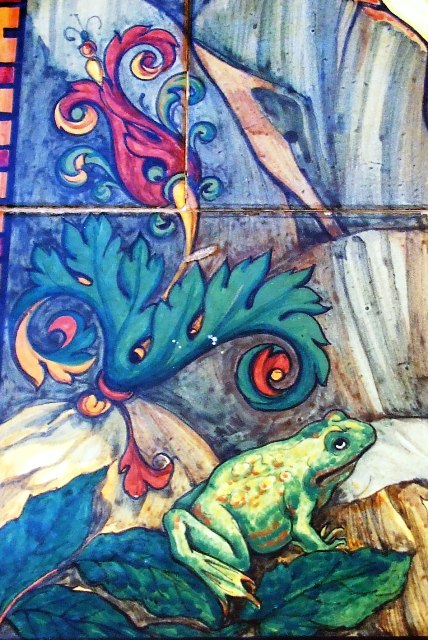
Hand-painted Animals from the Parish of Deruta

The Dove of Peace in the Garden of the Parish in Deruta


The sheep and the wolf with the Basilica of Assisi in the
background

A frog and a beautiful acanthus leaves detail!
**************************************************************************
The Tau is the symbol of Saint Francis of Assisi. My photos above are casually in the shape of a Tau with the Dove of Peace on top. The ceramics paintings above date back to the 1930s. 

domenica 9 gennaio 2011

Deruta ceramics: The Renaissance Loving Cups

If you wish to know more about Renaissance tokens of Love visit my first blog: www.bertabella.blogspot.com 


Detail of a Loving Cup
Credit: VAM London
In Italy at the end of 15th century gentlemen started offering ceramic loving cups (or gifts of love) to their beloved on specific occasions: weddings, engagements, baby showers and ballrooms. These pieces usually depicted a female bust and a flying ribbon around it with the compliments "bella" (beautiful) or "gentile" (kind).

Writings were various: “Be Ludovica”,”Lorenza B”, “Maria”, “La Giulia Bella”. Sometimes we find writings like ”Orelia B e Momolo suo servo“(tr. Orelia B and Momolo her servant), “Memento”, where “Be” and “B” stand for “Bella”.
In the early examples and later on we may find the name of the sweetheart only or symbols like the heart perforated by a spike, the heart in flames or the two hands tightened together. 


The origin of the loving cups is related to the change of attitude towards beauty and love in these centuries. Love was no longer concealed like it was in the Middle Ages and men wanted to make it eternal and show their feelings.

Loving cups were produced in several shapes, such as plates, spout pitchers, soup cups, amphoras, double handled vases and salt containers. According to the festivity each loving cup had a different shape and usage.
As an example the loving cup as a memento of the ballroom was filled with almond candies and sweets and it was dedicated to a young lady. Apparently this is how the tradition of favours started.
On the contrary the loving cup for the bride was accompanied by a tablecloth with an equal inscription. The married couple would drink out of the same cup to ensure fertility.
In the Renaissance loving cups became very popular and reached their richest expressions in colours, details and shapes. Local famous artists such as Perugino (1450-1523) and Pinturicchio (circa 1454-1513) were taken as examples.

Local craftsmen took inspiration from these artists and painted beautiful women. They had several examples of “Bella’s portraits so that the commissioners could have a selection to choice from. This might be the reason why many women did not match their real sweethearts.
Portraits were painted in blue, yellow, brown and green on a dark blue ground, and covered with a high sheen glaze.
Classical literature was also a source of inspiration for the floral intricate patterns enriching portraits especially when dedicated to engagements and weddings. Some examples of loving cups are painted with mythological stories with love subjects.
The tradition of loving cups lasted for a long time and we may still find examples in the 18th century. Several changes in styles have occurred. Interesting pieces may be found in private collections and museums.


**************************************************************************
The last decades of the 15th century were celebrating the end of the plagues in Deruta and new horizons  for the ceramics industry from the political and economical point of view. 

sabato 8 gennaio 2011

Deruta history: The Plagues

A detail of the fresco with the writing:
“DECRETO PUBLICO DE(R)UTA ANNO DNI MCCCCLXXV(II/III)"
(tr.public decree of the town of Deruta in the A.D. 1477-1478).

The last plague devastating Deruta in the second half of the 15th century dated back to 1476. The Deruta community celebrated the end of the sufferings with the order of a votive offering (ex voto) to the artist Pietro Perugino in 1477-1478 and portraying the Saints protectors Rocco and Romano, which are considered as anti-pestiferous.

The artwork is a fresco which has been in the Church of Saint Francis until recent times, when it has been detached and transported to the Deruta Painting Gallery. A beautiful band in the fresco portraits the landscape of the town of Deruta (see photo). 

It is also part of the recent history of Deruta the attribution of the fresco to Pietro Vannucci, known as "Perugino" by Professor Pietro Scarpellini, leading expert of Perugino's art and life and great professor of the University of Perugia. The painting was formerly ascribed to artist Fiorenzo di Lorenzo.

*************************************************************************
Professor Pietro Scarpellini passed away in 2010 at the age of 83. He has been one of the most important scholars of the town and of the University of Perugia. He was my professor of Medieval and Modern Art. 

De (the) Ruta: the plant of Antique Castle Walls

The stylized flower
of the blooming "Ruta"
The Coat of Arms of
Deruta
In the coat of arms of Deruta, on top of the castle there is an example of the plant of the "Ruta".

The common "Ruta" whose original name in Latin is "Ruta graveolens", when blooming  looks a lot like the flowers of the "Ricco Deruta" and "Raffaellesco" patterns, which are the historical Deruta designs.

The "Ruta" plant is a medicinal herb and at the time was considered as a protection against the plague.

In fact Deruta in the second half of the 15th century was repeatedly devastated by this mortal illness.

The detail of the plant of
"Ruta" (Tr.Rue) on top of
the castle
In the coat of arms guide line it is stated that the Deruta symbol of the plant must be represented on top of the tower by three small twigs of this shrub, that grows on  the rocky walls of the Castle of Deruta.

The origin of the name of the town of Deruta has several thesis and this is our favorite one!

The English name for the common Ruta is "Rue" and is also known as "Herb of Grace".


********************************************************
Saying:" La Ruta ogni malanno spegne" (tr. the Rue is the freedom from any diseases).


----


FRIENDS OF CAMA 
Join the Facebook Page to Receive Blog Updates 
posted by Roberta Niccacci

NEW!

Now on Twitter


venerdì 7 gennaio 2011

Deruta ceramics: The Renaissance Plate of Saint Claire of Assisi

The Renaissance plate
of Saint Claire
One of the most recent acquisitions of the Ceramics Museum of Deruta is a ceramics plate dating back to the Renaissance with the image of Saint Claire.

The Ceramics Museum art historians found this plate in a flea market, nowadays trendy for shopping.

The name of the Saint is written on the flying ribbon in the same style of  the Loving cups. The flying ribbon is also called "banderole".

Saint Claire founded the order of the "Clarisse" (poor Claires) but in Assisi it is possible to find many different orders of monasteries, among which several ones are open to hospitality in their "foresteria".

Our region is also the land of Benedictines, that we like in particular for their motto "Ora et Labora" (tr.pray and work). Saint Benedict is the Saint Patron of Europe and was originally from the town of Norcia, which is worth visiting.

giovedì 6 gennaio 2011

The Saint Francis Aedicule: detail of the Red Flags

Detail of the ceramics plaque of the Saint Francis Aedicule in Deruta

The red flag on the left carries the symbol of the Tower (the original coat of arms of the town of Deruta before the addition of the griphon) and the red flag on the right carries the symbol of the Vase with handles (still in use for advertising Deruta ceramics).
Red flag with the Tower

These details and colors are "bellissimo"! 

When I first visited the United States I thought that the refraction of  light was different than in Italy. All the colors seemed brighter to my eyes! I still think that this is the reason why Americans like striking colors for their ceramics. 

Indeed the most popular Deruta patterns in the United States are the so called "Geometric Patterns", which are very colorful. The history of the geometric patterns is very recent and finds its origin in the simple patterns painted by ceramics apprentists to learn the ceramics art since the Renaissance times. It is thanks to the talent of Mr. Franco Mari, artist in Deruta,  that the Geometric patterns were first launched in the United States market in new and rich original versions, which were immediately appealing to the public.

Red flag with the Vase
Nowadays contractors without scruples, ex Franco Mari workers and others are producing the original Franco Mari Geometric patterns. In the meantime Mari has gone a step forward and created new and more intricate patterns. But his first patterns are still the best sellers. At least the new producers could pay a royalty to Franco Mari but in Deruta the rule is "Mors tua, vita mea" (tr. your death is my life), therefore it is not necessary to go too far to find unfair competition, rather than in the fakes from abroad or in the decals (which serve completely different markets like chain stores, unreliable retailers or trap shops depending on the level of distortion).

The same destiny is now expecting the traditional Cama patterns. The Cama tracing papers are now being reproduced without the company's consent and I can tell you, this breaks your heart. Cama has been copied a lot but noone has ever dared to copy her tracing papers. This is why I am on Franco Mari's side. Patterns interpretations belong to their creators and for their artists they are priceless.

**************************************************************************
Very delicate issue (double red flag!) but the point is:  how can we fight for a better world if we let business overcome  values? Saint Francis is a testimonial of the attitude of respect of  values as regards to business. 

mercoledì 5 gennaio 2011

A famous witch from Deruta: La Strega Matteuccia


Deruta has got several satellite villages in its territory that belong to its Municipality. One of them is the village of Ripabianca, famous for its ceramics large oil containers and planters, which are made of unpainted sealed bisqueware.

One of its citizens in the Renaissance was the witch Matteuccia, who unfortunately for her was born in the wrong times and was burned in the main square of Todi in 1428.
Witches of modern times

She was a famous sorceress at that time and had a large clientele from all over the places, because she was well known for her healing remedies based on herbs and enchanted potions.

Twelve days after Christmas in Italy, on January 6th we celebrate the Epiphany which is  both a religious and a pagan holiday.  On behalf of the secular side of the holiday on this day witches called "Befana" are all over Italy to forward gifts to children. 

The Epiphany is the last holiday of the calendar before Easter, which gives the start to the new season of holidays and solemnities, starting  the new cycle of life with the rebirth of nature through springtime. 

Life, nature, seasons and human relationships are common fonts of the religious and of the pagan holidays which run parallel in Italy. The most beautiful number the two celebrations of life have in common is the sacred number 12 (i.e. twelve apostles, 12 months, 12 days, 12 stars crowning the Virgin Mary in the book of the Apocalypse).

++++++++++++++++++++++++++++++++++++++++++++++++++++
Ripabianca is now under the territory of Deruta and as a consequence under the district of Perugia but in the Renaissance this village was under the district  of the town of Todi.

Curiosity:
The most recent movie about witches has been released this year starring Nicholas Cage, Cama customer since 1993. The title of the movie is "Season of the witch". The movie gives us an idea of what the world looked like in the 1400s with impending plagues.

--------------------- 


Original Posts by Roberta Niccacci -

FRIENDS OF CAMA 
Join the Facebook Page to Receive Blog Updates 


NEW!

Now on Twitter


martedì 4 gennaio 2011

Meniconi-Dolgorouki Wedding Gift made in Deruta, Italy

Deruta Wedding Gift Plate
Credit: Ceramics Museum of Deruta 

 DESCRIPTION
September 15th, 1903 celebrated the wedding of a member of the Meniconi Family, Counts in Perugia and of an heir of the Dolgorouki family, Princes from Russia. Mr.Luigi and and Mrs.Vanna Andreoli from Perugia ordered their gift for this important occasion in Deruta.

The plate is a photograph like hand-painting of the couple. On your right the Meniconi family's coat of arms (originally Meniconi-Bracceschi). On your left the Dolgoroukis' coat of arms.

Writing upper part of the plate: "NOZZE MENICONI-DOLGOROUKI XV SETT MCMIII" (tr.Nuptials Meniconi-Dolgorouki 15th of September 1903);
Writing lower part of the plate: "LUIGI E VANNA ANDREOLI OFFRONO" (tr. gift from Luigi and Vanna Andreoli).


-----------------------------------------

- Original Posts by Roberta Niccacci -

FRIENDS OF CAMA 
Join the Facebook Page to Receive Blog Updates 

NEW!

Now on Twitter


lunedì 3 gennaio 2011

Deruta pottery history: The aedicule of Saint Francis


In the year 1220 Saint Francis was on his way to France.
A detail of the ceramics decor of the aedicule. 

The third and last entrance to the town of Deruta, also known as the Castle of Deruta, is the "Porta Perugina" (Perugia Entrance door) which belongs to the contrade "Valle".

On the street that takes to this entrance from the main street, there is a lovely aedicule dedicated to Saint Francis. We show here a detail of the landscape of Deruta which is supposed to portrait the town in 1220, six years before the passing of Saint Francis (The Saint is praying on the right side of the ceramics plaque). 

From the plaque, which is part of the aedicule's ceramics decoration, we notice four sites of smoke and red flags. Hopefully the town was not on fire or subject to any invasions, supposedly the smoking areas are meant to be the exhausts from the kilns operated by wood supply.

But from what we know the first document evidencing the trading of ceramics from Deruta to the town of Assisi goes back to the year 1282 (a supply of pitchers to a convent of friars). This is the earliest date to which goes back the ceramics tradition of Deruta.

Therefore we go for the option of the implanted memories of the ceramics artist of the time, Mr. Amerigo Lunghi who painted the ceramics plaques and tiles on September 1927, who gave us for granted that ceramics factories already existed in Deruta at the time of Saint Francis.

************************************************************************
"Pax et Bonum" (Peace and Goodwill)  is the saying invented by Saint Francis and is also the blessing that friars still use when taking leave.                            

Deruta famous factories : "Società Maioliche Deruta".

The Castle of Deruta (downtown) in 1940.

Walking from the main entrance of the town of Deruta towards Castelleone, on the right side of the street we  may admire an aedicule for the prayer with a beautiful ceramics plaque of Deruta.

The buildings represent private homes and Churches in the upper part of town and the ceramics factories, which at that time were located downtown Deruta (1940), in the lower part of the plaque.

Detail of the plaque

The buildings that belong to the "Società Maioliche Deruta" factory are the five annexes in the lower row of the ceramics plaque, which are designated with the following descriptions (from left to right):
1. magazzino - reparto tornianti (warehouse - handthrowing area);
2. magazzino - reparto pittori (warehouse - painters area);
3. majoliche - direzione (factory head offices);
4. reparto pittori - reparto vernici - reparto terra (painting room - glazing room - greenware room), forno a   legna (kiln by wood);
5. reparto formisti (shaping room) - reparto stampatori (moulding room).
The logo of the "Società Maioliche Deruta"
factory, a vase dated 1358. 

The "Società Maioliche Deruta" factory is no longer in business but has contributed immensily to the growth of the art of Deruta.


***********************************************************************
The main gate to the town of Deruta is the Gate of  St. Michael the Archangel (Piazza district). The other gates are the Gate of the Borough  or Todi Gate (Borgo district) and the Perugia Gate  (Valle district) for a total of three gates.