Blog's Translator

venerdì 27 settembre 2013

Safe Travels, St. Catherine of Alexandria!


St. Catherine of Alexandria painted by Raphael  (Urbino 1482- Roma 1520)
'St. Catherine of Alexandria', painted by Raphael at the beginning of his career is going to be the Ambassador for Urbino in its bid to become the European Capital City of Culture in 2019.
This work of art will be exhibited at the Italian Culture Institute of New York from October 1st - 28th October. 

St. Catherine of Alexandria was very important in the Renaissance period and we can find paintings of her in museums and churches throughout Italy as she was the Patron Saint of Arts. 


Recently, I have been to Puglia and Liguria and I was impressed to see many paintings of St. Catherine, despite knowing she was a very popular saint in the Renaissance period.  I found a fresco of her in the Cathedral of Ostuni (Brindisi) and a painting in the Cathedral of San Nicolò in Pietra Ligure (Savona) in which she is painted with a piece of breaking wheel and an elephant,  probably with reference to her North African origins.


St. Catherine of Alexandria is mentioned in the Legenda Aurea and it is celebrated every 25th of November.  In Deruta, St. Catherine is the Patron Saint of the town and of potters.  Therefore on the 25th November every year, all businesses are closed to celebrate the day with many social events. 


St. Catherine of Alexandria in the Cathedral
of Pietra Ligure, Italy is painted with a little elephant
next to her. 


Proofreading by A.S. 


Parmigianino, Mystic Marriage of St.Catherine of Alexandria at the hands of baby Jesus (c. 


More posts about St. Catherine of Alexandria in this blog: 

1. http://friendsofcama.blogspot.it/2010/08/november-25th-feast-of-saint-catherine.html

2. http://friendsofcama.blogspot.it/2011/06/deruta-symbols.htm

FRIENDS OF CAMA 
Join the Facebook Page to Receive Blog Updates 


NEW!

Now on Twitter

mercoledì 18 settembre 2013

"C" for "CANCER"


The horoscope sign of the CANCER in the celestial vault and constellations.
I am very fond of the horoscope sign under which I was born. 
(original drawing of  Alexander Jamieson).


Cosimo I de' Medici was born in June under the Gemini sign. However in paintings, bas-reliefs and frescoes describing his noble personality he prefers the Capricorn sign because it reminds him of when he was elected Duke of Florence in January 1537 and his birthright as a politician.  


The horn of plenty is part of the
Capricorn Mythology 
During Cosimo's time the Capricorn sign was a sign of power. Indeed two important personalities were associated with this sign: Emperor Augustus and Charles V of France.  In addition Capricorn was the birth sign of his famous ancestor Lorenzo de' Medici, known as Lorenzo the Magnificent. 


Horoscope signs in the celestial vault
Image: Museo Galileo Florence, Italy

My first thought was Cancer to be used for this post because it alliterates with my list of short posts starting with "C".  The only thing I could think of is that my horoscope sign reminds me of the start of a beautiful marriage as I am a honey moon baby. Which means a lot to me and later I discovered a connection between Cancer and Capricorn which could be more interesting. In its turn Capricorn came to  mind from the word capra (tr.goat) as the Capricorn is half a goat and half a fish. 


In The Renaissance Capricorn was a symbol of power. 

As a matter of fact Cancer and Capricorn have much in common if we consider astrology as the ancient science of reading the celestial vault as part of life and mutual influences in the universe: heaven and earth, communion of macroworld and microworld. In this perspective Cancer and Capricorn are called respectively north gate and south gate, they are the signs of the summer solstice and the winter solstice.  Furthermore they are part of a process of renewal on which they are inscribed as gates of an egg -symbol of rebirth. In fact they are the opposite! 


This is my fifth post of short  stories entitled "Cake Stands for Cama": stories about my favorites starting with "C".  I hope you enjoyed it!


-------------


Original Posts by Roberta Niccacci -

FRIENDS OF CAMA 
Join the Facebook Page to Receive Blog Updates 


NEW!

Now on Twitter


giovedì 5 settembre 2013

"C" for "COLORS"


The symbols of peace (dove) 
and plenty (cat).
Peace is on top of plenty.
Last year I found out something interesting regarding the family crest of an Italian noble family of the area in which I am currently living.  It is important to me because it is related to colors and their meaning.

heraldic dove 
The family crest is divided into two horizontal parts: the upper blue background is on top of the red part, wrapped by a classical gold/yellow ribbon. By looking at the family crest I suddenly felt I could relate to the colors on a personal level: blue for the color of my father's eyes and red for the family's workshop floor at Cama's. 
                                      
The family crest on a fresco surrounded by Renaissance grotesques. 
Heraldic cat
(Creative Commons Attribution 3.0 License)

It is thanks to the crest's symbols, the dove and the cat, that I understood the meaning of its colors: blue stands for peace  (a dove carrying an olive sprig), and red stands for abundance (a walking cat with a majestic head).  Indeed the sign of a well-fed cat is indicative of wealth whereas the dove is an international symbol of peace. 


But there is more to it. By studying the relationship between peace and abundance, I also discovered that in mythology peace accompanies plenty, the two allegories are described and painted together. In classical ages, events happened through the action of couples, just like the sparkle of love!

This is my free interpretation of the family crest by looking at it through the eyes of my experience, the colors of my time at Cama, and Renaissance symbolism. I hope you are enjoying my discoveries with me. 

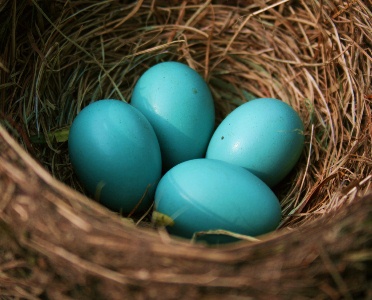
Tiffany Blue or 'Robin's Egg Blue'
One of the pastel shades of red: candy pink


note: I am learning with this post that the American Robin lays blue eggs. This color is called 'Robin's egg blue'. It's better known as Tiffany blue. I love this color! 


This is my fourth post of short stories entitled "Cake Stands for Cama": stories about my favorites starting with "C".  I hope you enjoyed it!


-------------


Original Posts by Roberta Niccacci -

FRIENDS OF CAMA 
Join the Facebook Page to Receive Blog Updates 


NEW!

Now on Twitter

mercoledì 21 agosto 2013

"C" for "CATHERINE"


The Mystic Marriage of Saint Catherine of Alexandria (c. 
by  Italian Artist Parmigianino


In times gone by olive picking in Italy began on November 25th the Feast day of St. Catherine of Alexandria, who is the Patron Saint of Ceramicists, a popular Saint in the Renaissance period.  Although olive picking starts earlier in November nowadays, St. Catherine's is still celebrated - exactly one month before Christmas. 

St. Catherine of Alexandria has been painted in many churches in Italy and by famous artists such as Parmigianino and Raphael. The Saint's symbol is a barbed wheel with which she was originally tortured but saved by angels.


In times gone by olive picking in Italy began on November 25th 
the Feast day of St. Catherine of Alexandria,


St. Catherine of Alexandria in the Renaissance period was considered an inspirational model. Her life is described in the famous "Legenda Aurea" (tr. Golden Legend, a best seller in the Renaissance written by Jacobus de Voragine about the life of Saints) and remembered for her mystical marriage at the hands of baby Jesus. 

Recently I saw paintings and frescoes of St. Catherine of Alexandria in the Cathedral of Saint Nicholaus, Pietra Ligure (Savona) ~ Co-Cathedral of Ostuni (Brindisi) ~ Hospital of the Innocents, Florence ~ 


                                     --------------------

This is my third post of short stories entitled "Cake Stands for Cama": stories about my favorites starting with "C".  I hope you enjoyed it! 


--------------------- 


Original Posts by Roberta Niccacci -

FRIENDS OF CAMA 
Join the Facebook Page to Receive Blog Updates 


NEW!

Now on Twitter


mercoledì 14 agosto 2013

"C" for "CHAMELEON"


In the Renaissance, the Chameleon was the symbol of Air. 

A few years ago I started the tradition of regularly traveling to Florence by train to visit the city. I have visited many places in the city so far: museums, churches, exhibitions, and each time I come back home feeling fulfilled. I am currently following the city of Florence on Facebook and Twitter for updates regarding temporary exhibitions. The last exhibition I saw was "Alchemy and the arts" which enabled me to complete research I originally started in Palazzo Vecchio. 

Indeed Palazzo Vecchio is my favorite historical building in the city, home of Cosimo I de' Medici, grand duke of Florence in the Renaissance period. This is where I discovered my greatest find: the studio of Francesco I de' Medici, Cosimo I's son. By looking up at the ceilings I noticed the four elements of the universe translated into symbols. With much joy, I saw the chameleon next to a rainbow. It was the symbol of air. 

Sometime before I had already chosen the chameleon as the mascot of Cama, because of the similarity of their names. Additionally, the chameleon adapts perfectly to its environment and can explore the world 360 degrees thanks to its eyes. Plus it has extra strength that comes from the lion in it. Our chameleon is made of the colors of the rainbow and is a girl! 


This is my second post of short stories entitled "Cake Stands for Cama": stories about my favorites starting with "C".  I hope you enjoyed it! 


----------------------------------------- 


Original Posts by Roberta Niccacci -

FRIENDS OF CAMA 
Join the Facebook Page to Receive Blog Updates 


NEW!

Now on Twitter

lunedì 12 agosto 2013

"C" for "CHANEL"

Pink is the color that comes to my mind
when I think of Chanel n.5


The refined town of Piegaro in Italy is twin city with Verneuil-en-Halatte, France where the famous Chanel perfume is produced. Piegaro at one time was also known as 'Little Paris' so this makes this event very romantic. 

The most wonderful compliment I ever received about my family's workshop is that of Cama - Chanel of Deruta. I will never forget it. Therefore such coincidences in my life along with other ones started to make me dream about a future in this tiny town where destiny had brought me out of the blue. 


Innovations
Before 1921 perfumes were made from the essence of single flowers.
Madame Chanel created the first bouquet of flowers, eightly of them. 


Regarding the subject of innovations, Madame Gabrielle Chanel with her Chanel n.5 invented the concept of perfume that we know nowadays, a bouquet of flowers. Before Gabrielle Chanel perfumes were made from one flower essence only. Because of the fact that the rose was way too romantic as an essence she ordered her personal parfumeur not to take roses into consideration, on the contrary he  included the rose to a bouquet of about eighty selected flower essences including mostly musk and jasmine.


My moving to Piegaro, Italy came out of the blue. 


This is my first post of short  stories entitled "Cake Stands for Cama": stories about my favorites starting with "C". 


----------------------------------------- 


Original Posts by Roberta Niccacci -

FRIENDS OF CAMA 
Join the Facebook Page to Receive Blog Updates 


NEW!

Now on Twitter


sabato 3 agosto 2013

Cake Stands for Cama

"Cake Stands for Cama": my play-on-words originating from the expression: "C" stands for Cama.

Soon on this blog a collection of ten short stories regarding people, emotions, facts, things, imaginary animals starting with "C" like in "Cama". These stories include notes of my dreams and my studies regarding Italian Renaissance Art. I wish you to enjoy my path of rebirth bringing new life to Cama. 


Follow me on Twitter and Facebook to receive updates!
www.facebook.com/friendsofcama
www.twitter.com/FriendsofCama


mercoledì 31 luglio 2013

Cama's True Colors


St. Catherine of Alexandria, St. Patron of
ceramicists, painted by Raphael circa 1508,
National Gallery, London


Note

During my researches I discovered something very interesting about the meaning of colors. I wrote a post about this subject some time ago, describing a classical Renaissance painting by Raffaello, the St.Catherine of Alexandria, Saint Patron of ceramicists and celebrated every year in Italy on November 25th. 


Gemstones are the symbol of earth in
the Renaissance period. 


In this painting we can see the classical colors in the patterns of the Deruta Renaissance period, next to the undermentioned gemstones, the symbol of earth, you will see I have noted the gemstones color together with their significance.

Ruby (red): charity, love, abundance;
Pearl (white): purity;
Emerald (green): beauty, the eyes of Venus;
Rock crystal: knowledge;
Diamond: strength;
Sapphire (blue): celestial purity, peace;
Topaz (yellow): friendship. 


~ proofreading by A.S. 
-----------------------------------------

- Original Posts by Roberta Niccacci -

FRIENDS OF CAMA 
Join the Facebook Page to Receive Blog Updates 

NEW!

Now on Twitter

mercoledì 24 luglio 2013

Time for Action!


The famous painting on the ceiling of the house of Mr. Giorgio Vasari 
in Arezzo, Italy: "Allegory of Virtue  chasing away Fortune and Envy"  (1548) 


Sir Giorgio Vasari (1511-1574)  is one of the most important art scholars of the Renaissance period in Italy. Artist and architect of the Palazzo Vecchio in Florence, admired by Cosimo I de' Medici, Sir Giorgio wrote a memorable biography of artists.  The first edition in 1550 was dedicated to the Duke of Florence. 
Giorgio Vasari was born in the city of Arezzo where his residence and gardens are now a State Museum. 
The triumph of Virtue is sealed
by a luxury brooch

In the main room of Vasari's beautifully painted home in the style of Palazzo Vecchio, where he received his guests, an allegorical fresco on the ceiling reassures us that Virtue wins over everything, even over Fortune, which is subject to unreliable changes. Virtue wins also over the pitfalls of Envy, to whom Virtue is giving a powerful kick while grabbing fortune by the hair. 
Virtue for the Renaissance period was the art of doing things well:  it was a specific gift acknowledged to artists, whose destiny was subject both to envy and fortune.  Virtue is the only allegory provided with wings that make her fly towards the horizons of eternity. Virtue is also carrying a sledgehammer in her hands, so be aware she is tough, her laurels give her much power. What is missing in this painting is Virtue's triumph and this is the last step of Virtue's endeavor. 
Giorgio Vasari himself was the author of this allegory and this painting is an invitation to be fearless, to believe in our gifts, and take risks: in the end, it's all good! 
Brooches in the Renaissance
were a symbol of virtuosity
 

A Cameo from the Piccolomini Library
in the Cathedral of Siena, Italy
by artist Pinturicchio, the artist of
details. 


Curiosity: take the time to look for details in Renaissance paintings. When you see a brooch both on men and women it means it is a virtuous person. Brooches on hats are the most interesting ones!


-----------------------------------------

- Original Posts by Roberta Niccacci -

FRIENDS OF CAMA 
Join the Facebook Page to Receive Blog Updates 

NEW!

Now on Twitter