Blog's Translator

mercoledì 17 agosto 2011

October 22nd, 2011: Deruta Pottery in Seattle, Washington

Hats & Tea
Fashion Show and Silent Auction 


We request the honor of your Presence 
at the Annual Fund raising auction and tea party
upon the First Appointment with Cama Deruta

on Saturday October 22nd, 2011
at Mercer Island Presbyterian Church
3605  84th Ave, SE
Mercer Island, Washington 98040

Please Join Us! 


For more information about the event and registration write to:
or call (206) 621-8474


Cama Deruta has made a generous donation of beautiful and valuable handpainted cups and saucers to increase financial support to the homeless women and children who comprise the community of the Church of Mary Magdalene and Mary's Place in Seattle. Also featuring a coffee pot, tray and vegatable dish. 

Church of Mary Magdalene and Mary's Place work together to provide day shelter for homeless women and children, offering meals, clothing, hygiene services information and referral to help women out of homelessness. 
An Ecumenical Ministry with homeless women. 

The hats and tea fashion show started 7 years ago showcasing the beautiful work of Annie De Vuono,  visit: http://www.devuonohats.com
Many thanks to Lisa Connolley  for  her cooperation in establishing the connection with the Church of Mary Magdalene/Mary's Place.


Follow Mary's Place on twitter: http://twitter.com/MarysPlaceWA and on Facebook: www.facebook.com/marysplacedaycenter

Become a Friend of Cama by joining the Cama fan page at: www.facebook.com/friendsofcama
an on twitter through Bertabella, our speaker from Renaissance times: www.twitter.com/bertabella

To know more about the Italian tradition of Bellas, visit: www.bertabella.blogspot.com

---------------------------------------------------------
If you wish to donate to the Church of Mary Magdalene, follow this link:
Remember to mention that you are a "Friend of Cama".

mercoledì 3 agosto 2011

The story of my dream for a retirement home in Deruta

Thinking of innovative ideas
for Deruta.  In the photo: entrance
door to the "Valle" neighborhood
facing Perugia.


View from the village of Piegaro, Italy
(photo by: Sissel Bendiksen) 
In the past three years my life has completely changed. My most recent life event is my moving to the village of Piegaro upon the border between Umbria and Tuscany. Piegaro is full of life and is the icing on the cake of my beautiful life story in recent times.

My family's workshop's events have ended up giving me lots of strength and joy of life. Funny enough I got energetic by going through a large amount of stress and hard trials and many times when I was tempted to give up on all fronts: the same path of a novel's hero,  for almost three years now. 

As a consequence of the recession my family has lost all their properties and material belongings. After the mourning, now I am feeling light and free, willing to look for new adventures. This experience has changed my life perspective more than anything before.  I am thankful to life, to my parents and to what life is offering to me. What I crave for right now is health, happiness and independence.  

In the beginning of my recent adventure in the world of business,  trying to help my family in recession times - without any experience as an entrepreneur -  I realized I was looking for solutions to problems that were impossible to solve. Additionally I met strong resistances on all fronts. The first thing I did early 2009 was  setting up an appointment with the mayor of Deruta. 

I got my appointment! I was all enthusiastic about a dream I had for the town of Deruta. This was my point; I said to the mayor that if customers cannot buy ceramics at the moment or the markets' demand is too low, I said that to me the best would be creating other points of attraction in the city of Deruta. As a consequence present ceramics as a second or third option. 


Art-therapy is in use in the best retirement homes
and in caregiving daycares for the elderly.

The mayor probably thought that my idea was crazy. Indeed he is all into ceramic urban furnishing in Deruta:  as an example he has had comfortable wooden benches replaced by ceramic benches that are so uncomfortable that older people do not use them any longer.  

Anyway this is the dream I had for Deruta and I wanted to share with the administration's first citizen: an art retirement home for the elderly. 

Why is it so special? My retirement home comes with satellite laboratories for the arts and crafts that families with children can use during week-ends as an alternative to visiting malls. Children do not come necessarily in touch with elderly people if their parents do not want to. But they can use the same spaces that the elderly use for their daily arts and crafts activities

Besides art-therapy, gardens stimulating senses
are part of modern caregiving daycare. 
As a second step the art retirement home areas can be enriched with rooms for art lectures, art meetings and cultural exchanges, a bed and breakfast and so on. 

I have had the idea of a retirement home in Deruta since 2004 when I got in touch with the world of the elderly as a caregiver. I mean how it should technically be. But this is not what makes this idea so special. 

What else makes my retirement home idea so special? There is a very funny story about a retirement home in Deruta. The elderly of my town would really love to see their dream come true. This is how the story goes. 

At one time someone very dear to the town of Deruta, a franciscan friar born in Deruta, wanted to create an ecumenical center there for the Jewish and the Catholic religions. His early death did not allow him to accomplish his project. However what's  interesting is that the word "ecumenical"was probably not too familiar to the elderly in Deruta. In their mind their friar friend wanted to open a retirement home for the elderly of Deruta; that he was thinking of them! He was so darling with elderly people. 

The elderly in Deruta still love the idea after more than 30 years. What a funny and beautiful story: an art retirement home in Deruta would be a wonderful project to accomplish. A way to say thank you to all the unknown Deruta artists who have worked in the ceramic factories and contributed to make Deruta famous in the world. And...in the same complex we could finally open an additional space for the Jewish and the Catholic ecumenical world! 


What would life be if we did not have beautiful stories to tell. 

----


FRIENDS OF CAMA 
Join the Facebook Page to Receive Blog Updates 

~ All things Italian, great Italian insights ~


NEW!

Now on Twitter

mercoledì 27 luglio 2011

The story of the singing rooster from Deruta and the musical notes.

Artist and friend Romano Ranieri in a recent photo.
(photo credit: Scuola d'Arte Ceramica Romano Ranieri)

In 1953 Romano Ranieri was attending the last year of high school, the fabled “Liceo Classico”.

During the summer of that year Romano entered the famous ceramics factory “G.Grazia” in Deruta as an apprentice. At that time workshops were structured in teams with  team masters and  a department head. Each apprentice had to follow strictly the rules of his master and of the workshop in general. Romano was selected to work in the team of Mr. Olivo Pelli.  

Mr. Olivo Pelli has been one of the greatest artists in Deruta for the ORVIETO rooster pattern. During that summer Olivo gave Romano the order of painting a group of dinner plates in the rooster pattern. “The plates were for a customer in the United States, whose initials were P.V.” – Romano remembers. The plates had to be finished within the day.

Romano started painting the plates and in the late afternoon he was making the last plate. Out of his initiative Romano created something new: next to the open beak of the singing rooster he draw the lines of the pentagram and 4 or 5 music notes without saying anything to his team master.

The plate was fired and after they discovered what Romano had done, even the department head, Mr.Virgilio Spaccini, had something to say and Romano was reproached for his doing something without the approval of his superiors. The plate was discarded and placed among the seconds.

One day the United States agent visited the Grazia factory. He inadvertently noticed the plate with the notes of the pentagram hidden among the seconds. He was ravished, full of interest for something new. The agent liked Romano’s plate so much that since then he only wanted the Orvieto rooster pattern with the notes of the pentagram!  

**************************************************************************

Romano Ranieri was already a very promising creative artist! Romano's father had been sending him to the home of ceramics masters in Deruta from a young age every single school summer break.With the passing of time, Romano Ranieri has been improving his talent for painting on ceramics also adding other supports like canvas and wood. He is now among the most important and best artists of the history of Deruta. In 2001 Romano opened a school where he teaches the art of painting. To know more about this artist and his school, visit the Romano Ranieri website.

Note for the reader -
PHOTOS OF ORIGINAL PLATES BY ROMANO RANIERI WITH THE SINGING ROOSTER COMING SOON! A FRIEND OF MINE OWNS THEM AS HE INHERITED THEM FROM HIS GRANDPARENTS BUT IT TAKES FOREVER TO GET THE PHOTOS. I WILL HAVE TO GO AND TAKE THE PHOTOS IN PERSON AND BE BACK TO YOU!


----


FRIENDS OF CAMA 
Join the Facebook Page to Receive Blog Updates 
posted by Roberta Niccacci

NEW!

Now on Twitter


martedì 26 luglio 2011

July 26th: The Borgo of Deruta celebrates the Feast of Saint Anne.

The most familiar image of Saint Anne
in the homes of  Deruta

Every year on July 26th Deruta celebrates the mother of the Virgin Mary, Saint Anne, in the neighborhood of town known as “Borgo of Deruta” or “Borgo Bello”.

"Borgo" is the name of the lower parts of Medieval villages or towns in Italy, usually the areas along narrow streets, where craftsmen and artists lived. This area was extended to the peasants who lived in the areas around the village itself especially for the use of the Church.

The veneration of Saint Anne (The goddess Ceres in the pagan tradition) originated from the worship of life, fertility, and of harvests. Saint Anne in fact is the Saint Protector of new mothers and new brides. We pray Saint Anne to ask help for fertility.

In Deruta every year on July 26th they would celebrate Saint Anne with a market selling animals for meat and products of the countryside and by opening the Church in honor of the rural world. The tradition continues nowadays in the Borgo of Deruta by opening the Church of Saint Anne to the public and by inviting craftsmen and merchants with all sorts of products. 

Nowadays the fair/market takes place on a Sunday that precedes or follows the 26th of July if this date is a working day. 

Happy Name-day to all our friends whose name is Anna, Anne, Ann, Hanna, Annina, Annetta and similar. 

domenica 17 luglio 2011

Cama Deruta: A Happy Ending Story for a Case Story

Cama Deruta: 
a business that goes beyond business

FOLLOW THE WONDERFUL STORY OF CAMA DERUTA

The happy ending story feed of Cama now available on facebook and  twitter. Become a Friend of Cama with just a click. We would love to have you in our circle. We will all be part of a beautiful life experience. Events in the United States and a very original solution for Cama to resume her beautiful work will be the occasion to access together new business paths as pioneers of a new way of purchasing beautiful Arts & Crafts.

THANK YOU NOTE

With this occasion I would like to send many thanks to the Friends of Cama in California, to the Friends of Cama in Germany, to the Friends of Cama in Italy and to the Friends of Cama in Canada for their support in the past couple of years. A thank you to the Friends of Cama in Australia.

Also welcoming the new Friends of Cama from Seattle, Washington.


BECOME A FRIEND OF CAMA,  BY JOINING OUR FAVORITE SOCIAL NETWORKS!
The Green Heart Revolution for a Green Art has started. Go green and follow the FriendsofCama!


lunedì 11 luglio 2011

Lost crafts: The Art of Straw Weaving in Piegaro

FIVE "fiascos" from left to right:
1. An old fiasco I found in the home I live.
2. The fiasco I bought in the Piazza of Piegaro from Peppina.
3. 4. 5. The fiascos I made at the classes of straw weaving! 

News From Piegaro, Italy - The art of straw weaving around the bottle called a "fiasco" belongs nowadays to volunteers promoting the town upon appointment of the cultural association "Il Borgo". Artists give free demonstrations to tourists in the Piazza in the evenings and for 5 euros you can take a "fiasco" home with you. The association "Il Borgo" gives all the revenues from the sales of these“fiascos” to the promotion of the art of straw weaving in Italy and abroad. It is also possible to take lessons at the local Glass Museum for the same price! 

Herewith follows a description of the art from the files of the Glass Museum in Piegaro: 

"Flask production is associated  with specific workmanship, called dressing, entrusted up until the 1970s to Tuscan straw-workers of Castelfiorentino, Certaldo, Montelupo, Empoli and Colle Val D’Elsa, and to flask dressers of Piegaro who used sun-dried marsh plants (scarcia).

At first, straw work was done inside the glasswork factories. Then, because of increased production, the containers were taken to the dressers’ homes. This activity served to supplement the modest domestic budget, or even maintain it completely, especially in moments of crisis. The women used to do piecework, for very long hours, often even after supper and on Sunday morning. They would work seated on little stools since this enabled them to hold the flask better.

Technique and Instruments

The scarcia was always kept soaked in water so that it would not break when used and would not cut the worker’s hands. When there was an urgent consignment, the women organized a work chain, leaving the best dresser to finish off the work […].

The only instruments used in this craft were often passed down from mother to daughter and included needles of various shapes and sizes, and a pair of scissors. The plants used to obtain the sala or scarcia were picked on the banks of the lakes or marshes. The scarcia was also used for the padded parts of the chairs.
fiasco on the left: binding technique,
fiasco on the right winding technique,
 classical of Piegaro.


The two most common working techniques were binding, where leaves of scarcia were inserted vertically between the base and the shoulder of the flask, and winding, which was used to cover a certain type of flask, the pulcianella, in which a cord made of interweaved leaves started at the base of the flask and was wound round up to the shoulder. A short cord was added to the finished flask to make it easier to carry when holding more than one container in the same hand".

(Credits: from the leaflets of the Glass Museum in Piegaro).

************************************************************************
Your staying in Piegaro: Visit the website of my friends Colleen Simpson and Tom Webb, owners of L'Antica Vetreria:  the first glass factory in Piegaro from the 13th century is now a beautiful Villa! www.anticavetreria.net

martedì 28 giugno 2011

Deruta history: The Grazia factory in Deruta

Class and prestige at the Grazia
factory in Deruta. 

My dream home for ceramics in Deruta is the Grazia factory. I love their building and their ceramics style. I wish they liked the idea of hosting Cama. I would make them part of the wonderful world of the Friends of Cama!

The Grazia factory is the oldest workshop in Deruta that made it from the 1500s. Indeed the Grazia factory is listed among the most ancient family run operations worldwide. 

In 2009 Electa Editor published the book "Museo della fabbrica di maioliche Grazia di Deruta" (tr. Museum of the Grazia ceramics factory in Deruta" ISBN-13: 978-8837063450), where the authors write for the first time about the date of birth of the workshop: 1527 A.D. Marco di Paolo Grazia was the name of the founder. He started the art of his family by renting a furnace in the borough of Deruta with the following description "ad artem vasorum fictilium" (English translation "The art of earthenware vessels").   

I would be grateful to the Grazia factory for dedicating part of their factory to my mother as the "heir of Grazia", what she is known for when in the 1980s the Grazia factory opened their laboratories to contemporary artists creating modern designs, while my mother Elena Niccacci was energetically restyling the traditional Deruta patterns for Cama. 

To me the work of my mother and the style of Grazia have the same "transferware" look, funny enough nowadays an appreciation to a handpainted ceramics piece that is very well done is that it looks like "decal".
A full of grace expression from
a Renaissance lovers' cup. 

Indeed a ceramics piece from Deruta can reach the perfection and can be flawless. The process to reach such a high challenge is much longer and takes more care and attention than any other process. This is one of the reasons for the higher prices of the ceramics pieces.

The work of my mother Elena Niccacci and her team goes beyond the perfect look. Her work is graceful and an expression of love and passion. Graceful literally translates in Italian "Pieno di GRAZIA".

If you google "grazia factory Deruta" the photo of the hands of my mother come up and lots of photos from my blog. This might be a sign of the destiny!

______________________________________________________________

Latest news as of September 18th, 2011 - Victim of the recession in Deruta, Italy is this time the famous Grazia factory. In the paper these days, the factory has sent their 18 employees home for two months for lack of orders. The Italian government will be supporting the artists according to the temporary redundancy program. 

-----------------------------------------

- Original Posts by Roberta Niccacci -


FRIENDS OF CAMA 
Join the Facebook Page to Receive Blog Updates 

NEW!

Now on Twitter

domenica 26 giugno 2011

The 15th Station of the Cross: Resurrection

Elena Niccacci receiving Pope John Paul II's blessing
at the year 2000 Jubilee celebrations.

Until recent times the Stations of the Cross in a Catholic church were a total of 14. You may check that in any Italian church upon your visits to our beautiful country.

It was Pope John Paul II who added the 15th Station of the Cross during his papacy (1978-2005). He decided that the 15th station of the cross was Jesus Christ's Resurrection.

Regarding Pope Paul II my memory goes back to the year 2000 when my mother Elena Niccacci received the Pope's blessing along with my family and the Cama artists.

Modern ceramic stations of the cross 
by artist and friend Professor
Claudio Monotti. 


My brother Andrea Niccacci deliverying the Cama plate to Pope
John Paul II in the year 2000. 
For this occasion my mother painted a large plate in the Cama traditional patterns that she offered to the Pope. On the back of the plate all the workers' and our family members' names.    

Cama's last visit to the Vatican with the workers had been upon the Sistine Chapel's restoration in 1994. In that year we rented a bus and visited the Vatican Museums with all the Cama assistants to introduce them to Michelangelo's and Raffaello's frescoes. These artists inspired the ceramic art in Deruta highly. It was important for us that they were aware of our art heritage by admiring these artists' works in person.

Ceramic artists in Deruta still use the same art techniques that were in use in the Renaissance period. Drawings were first made on cardboards and then transferred to the walls by using tracing papers. Close up photos of the Sistine Chapel's restored works of art showed us the tracing papers dots underlying the drawings' outlines. Such large dots. Seeing them was very impressive as artists used nails because of the frescoes' dimensions. In Deruta we are used to needles!


-----------------------------------------

- Original Posts by Roberta Niccacci -

FRIENDS OF CAMA 
Join the Facebook Page to Receive Blog Updates 

NEW!
Now on Twitter

sabato 25 giugno 2011

Deruta symbols

 
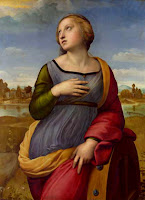
Raphael -
Saint Catherine of Alexandria


Herewith follows a list of symbols that I selected for you as symbols of Deruta:

The most important symbol of Deruta is the wheel. It is the symbol of Saint Catherine of Alexandria, who was tortured on a wheel. The wheel is the most important tool for creating everything that is round shaped in ceramics from the lump of clay.

Saint Catherine is the Saint protector of ceramicists and the Saint patron Day is November 25th. All workshops and shops in Deruta are closed on this day.

Saint Catherine of Alexandria was a very popular saint in the Renaissance period.

The plant of the rue in the Deruta
coat of arms (detail)
Another symbol of Deruta is the plant of the rue ("Ruta" in Italian) as per the coat of Arms of the City of Deruta. To me this is the true origin of the name "DE RUTA" rather than from "Destroyed". Who wants to visit a town that is destroyed?

Have you seen the most recent movie with Nicholas Cage called "Season of the Witch"? You may see what the plagues were like.

Raffaellesco by Cama, artist Elena Niccacci
A third symbol of Deruta is the dragon of the famous historical pattern known as "Raffaellesco", which takes inspiration from the grotesques painted by the artist Raffaello Sanzio (Raphael) in the Vatican rooms. On his turn he was inspired by the Domus Aurea (Golden home) of Emperor Nero. The pattern dates back to the second half of the 16th century.

For more about the grotesques go to this link in this blog.
Renaissance lovers' cup
from Deruta

The symbol of the city of Deruta in the advertisements is the vase called "gamelio"  (photo) which is a Renaissance lovers'cup and specifically in the luster technique. The lovers' cup was the gift of men to their beloved for special occasions such as engagement and wedding and was selected among several shapes. This vase can be found in ceramics plaques in the edicules of the town of Deruta and on the city flags.


***********************************************************************

Curiosity:
Nicholas Cage has purchased Cama products in the past, in particular the Raffaellesco goblets by Elena Niccacci either from Biordi's in San Francisco (Biordi Art Imports in San Francisco still has Cama pieces in stock) or from the Cottura stores in Los Angeles (wonderful stores no longer in business and Cama is proud to be among their suppliers). We would like to invite Nicholas Cage to one of our events in the United States in the future as guest star. Do you like Nicholas Cage?

--------------------


Original Posts by Roberta Niccacci -

FRIENDS OF CAMA 
Join the Facebook Page to Receive Blog Updates 


NEW!

Now on Twitter


martedì 21 giugno 2011

Pinturicchio: the artist of the details and of little things

Ceramics reproduction of
a Renaissance broche
originally painted
by artist Pinturicchio. 
Pinturicchio is one of the artists who inspired the ceramics of Deruta along with Perugino as local artists. Pinturicchio was born in Perugia in 1452 and died in Siena in 1513.

He is famous for the details of his works that you may admire in the Cathedral of Siena (on the left side of the Church, the so called "Studio Piccolomini" which is stunning) and in Spello in the Church of Santa Maria Maggiore (on the right side of the street going up to the top of the town) in the Cappella Baglioni as an example as well as at the Umbrian National Gallery in Perugia.

In 2008  upon the celebrations for the 550th anniversary of his birth, Cama reproduced one of his broches, which in the Renaissance was synonymus with virtuosity. Men and women wore broches equally.

sabato 18 giugno 2011

Cama, "The Chanel of Deruta": premises on Via Tiberina, 113 closed

Ciao 1950s! New millennium,
new home! 

I would like to inform the Cama customers and the Friends of Cama that as of June 18th, 2011 the workshop on Via Tiberina, 113 in Deruta is closed. This is an important step that will allow Cama to go forward and look for a new and exciting place, where resuming their art.

The original Cama logo 
whose letters 
are inscribed in the golden
number or golden section. 
The building you have visited until now was originally built late 1950s and was not the original building where Cama started her ceramics art. The workshop has been remodeled in the 1970s and late 1990s and has lost much of its original flavor. On the contrary we have kept the original logo and lots of enthusiasm to meet our friends and customers in a new place!

We have created a page on Facebook called "FriendsofCama" to honor the friends in the United States and in Europe who have been supporting Cama in her transition to a new rebirth.
Follow the Cama story through this blog and through Facebook. Become a fan!

Events and news coming up!

One of the best compliments ever received is that Cama is the "Chanel of Deruta". The works of Elena and Renato Niccacci are difficult to copy and right now there are people in Deruta struggling to make perfect fakes. This is quite a compliment, "imitation is the best way of flattering".

The original Cama Deruta logo is inscribed in a Golden Section also known as Divine Proportion, Golden Number, "Sezione Aurea" in Italian. The Golden Section was much in use in the Renaissance. The discovery is by graphic designer and stylist Marco Lucarelli from Perugia, Italy owner of Eidos. If you wish to contact Marco Lucarelli, email: eidos.staff@gmail.com, personable and exclusive creations for graphic and design projects.

venerdì 17 giugno 2011

How to Cope With Slow Times at Work


An article I wrote for eHow,  the famous social network in the United States. 

By bertabella, ex- eHow Member

I am a sales assistant for my family's operations and the slowest months in their business go from November to March. There is a lot of time for me to get bored or look for another job! With the economy slowdown things are apparently worse, therefore I think the secret is not to panic and on the contrary find creative solutions.

Things You'll Need:

  • patience
  • creativity
  • hope
  • interaction
Step1
What shall I do? Sometimes in certain kinds of business, you do not feel much the boredom because you are used to slow weeks and months. Especially in activities involving tourism, you work with customers only part of the calendar year. During show times you usually look for complementary activities to your job. This idea can be of help during slowdown! 

Step2
Find people tuned with you. The important attitude is to believe in what you do. During regular slow times it is important not to leave work or look for another job opportunity. On the contrary it is necessary to look for people stimulating your creativity and working with you on new projects.

Step3
Improve yourself if you want to help! Think that customers who like beautiful things have not disappeared. They are just scared or being careful with their money. Be patient. Do the same in your business. Do not invest on something that is not necessary. Invest on yourself only!

Step4
Do what your customers do! Try several attempts. Do not give up. Keep your budget as low as possible and work on ideas. Training is very important. Additionally, if you want to improve sales on a specific kind of merchandise, such as dinnerware, tableclothes and accessories, act at home as if you were your potential customer. As an example dress you table nicely and invite friends over to your home.

Step5
Shop for valuable things. Do not waste you money! Awareness is very important. Even during times of recession shopping is part of our life. Indeed it is a social event. A choral participation to life. Therefore encouraging the purchase of valuable pieces is a must. This would be a great help for everybody and prevent us from buying inexpensive things we do not need just because we are attracted by the lowest price.

Tips & Warnings

  • do not panic
  • be creative
  • find complementary activities to your business
  • be positive

Comments_

on 1/6/2009 Excellent article. I too am in the service business and need to keep a positive attitude until times improve!

On 1/6/2009 Good tips - thanks for sharing.

On 1/6/2009 Indeed. Good article, and you're right, people are shopping! The trick is to get in on selling what they all can't live without~ 5* and congrats on your new writing status!

****************************************************************

The original logo of
eHow. visit www.ehow.com
This is an article I wrote for eHow.com a couple of years ago. I had subscribed early 2009 while surfing the net in search of solutions for my family's ceramics business. I really enjoyed writing articles for eHow and I had an audience! I loved their ready made format for writing articles. It was cool! 
What happened with eHow is that they communicated to me that my writing was poor and they started erasing my beautiful articles. My writing was not up to the American standards. I got very sad about what happened and I quit eHow. If I were to analyse the problem now, I would not quit eHow, on the contrary I would ask them to offer an editing service to their members. They would have made money at least with me! I miss writing for them. 
Everybody can be creative. 

venerdì 20 maggio 2011

The Niccacci historical Mill is closing

The flour from the Niccacci mill
was a must in the kitchen
The historical mill owned by a branch of the Niccacci family and located on Via della Molinella in Deruta will close at the end of the month of May.

It is a historical mill that goes back to the 1400s and supplied the Papal States located in Perugia. Originally the mill was operated by water.

Owner Agostino Niccacci says there is no more market for his flour. His flour was the best in the area and the most reliable in terms of quality and health. Larger operations have taken over for the retail supplies as well as supermarkets for the single customers, he says.

We are going to lose more than 600 years of history of our town. Ciao Molinella!

mercoledì 18 maggio 2011

The 5% discount rule and the slaughter game

My father Renato Niccacci taught me the basic rules of selling ceramics when I was a little girl. One thing I learned from him is that if a customer asks for a discount, you cannot say "no" and the maximum you may offer is a 5% discount. I think this is the answer of an honest artisan. If you give a higher discount, that means you were asking for a higher price to start with or in some cases you are under pressure because of recession times, if we think of nowadays. This makes sense.

In my experience at Cama I never had to negotiate with customers and there was a lot of respect for the work of my family and workshop. Therefore at the workshop I applied the 5% rule.

Another important point is that customers always came back to Cama for her quality and for the services we offered. This was one of the most rewarding experiences I had as a sales assistant. Based on the quality of the products, the service and care, customers brought more and more customers by word of mouth, creating a community of friends of friends. A wonderful enchanted world with some echoing of the world around us in Deruta but enough to know that we were successful.

As you know Cama has recently interruped her production and I look forward to the reopening that I wish to happen within 2012 at a different address. While waiting for this to happen, I am taking clients to other workshops in Deruta for the first time in my life: a new world is opening up in front of my eyes!

Yesterday I had the opportunity of meeting my first small group of visitors. I have a story to tell because I watched a slaughter game. I will describe herewith what happened with notes of the critical points. I hope this will be of help.

We did a brief tour of downtown and visits to a couple of large producers in the lower part of town. I learned a lot of interesting information. First of all the first competitors of Deruta are not the Chinese or the Romanian but the Deruta artisans themselves, they are all competitors. This I knew from my previous experience. Second in Deruta there are no regulations in the prices applied. Actually most of the time there are no price tags at all. No rules for discounts. No rules for shipping costs. Differences apply if you buy from a workshop or from a store. Some places carry imported ceramics. Really puzzling. Third thing, lots of dust on their ceramics.

I took the group to a collegue's workshop in Deruta for the tour of the factory. This workshop has reasonable prices. Quality is acceptable on some pieces, other pieces are ordinary but they carries one variation of the Raffaellesco dinnerware I really like. Customers were interested in two Raffaellesco full place setting with accessories and another customer was interested in a different set. The customers decided they wanted to compare the selected items with other producers, therefore they would be back. Customers came back to the workshop asking for the same lower price they had found elsewhere. She said she couldn't afford such a discount which was about 25% from the original price. After some back and forth, at the end the workshop did not do the sale. What happened is that the customers bought their ceramics sets from an individual ceramicist who offered a variation of the same pattern, shipment included, for the price they had decided to spend on a Raffaellesco dinnerware set, offering them a big discount.

On my side I made the mistake of not following the group for the whole time. I waited at the workshop like I used to do at Cama. Therefore I did not see the products they purchased. I do not know what the quality level of the product was, I do not know if there is lead in the painting nor if the shipping service is reliable as well as their insurance service and so on. By doing some research afterwards, this ceramicist is possibly using the decal for the dragons and the rest of the product is handmade. By following them I might have warned them about what they were buying.

Moral of the tale: Customers bought the lowest price. Customers bought the price. For Deruta this can be a slaughter game. Now I am thinking about what I can do to help both, the customers and the producers. I am feeling concerned.